>Monday, a Time to Give Thanks.

>

My Daughter’s picture

Paul’s words keep resonating in my heart, my mind… they come out of my mouth, slowly for I don’t want to trample.

Philippians is known as the Epistle of Joy, and Paul’s first mention of JOY is when he says:

“I thank my God in all my remembrance of you, always in every prayer of mine for you all making my prayer with joy” (v.3-4 ESV)

If this is the Epistle of Joy, then I certainly want to go deeper into the meaning of such word. John MacArthur says,

“Spiritual joy is not an attitude dependent on chance or circumstances. It is the deep and abiding confidence that, regardless of one’s circumstances in life, all is well between the believer and the Lord.”

He goes on and gives us several features of a biblical theology of true joy:
First, joy is a gift from God. (Psalm 4:7-8;  Psalm 16:11)

Second, God grants joy to those who believe the gospel. (Luke 10:11-12; John 15:11)
Third, joy is produced by God the Holy Spirit. “For the kingdom of God is not eating and drinking,” Paul said, “but righteousness and peace and joy in the Holy Spirit” (Rom 14:17). 
Fourth, joy is experienced most fully as believers receive and obey God’s Word. (Jer.15:16; 1 John 1:4)
Fifth, believers’ joy is deepened through trials. The full reality of joy is experienced when it is contrasted with sadness, sorrow, and difficulties. (I Thess. 1:6; 2 Cor. 6:10; James 1:2; I Peter 1: 3-6)
Sixth, believers’ joy is made complete when they set their hope on the glory of heaven. They are always to be “rejoicing in hope” (Rom. 12:12; 1 Peter 1:8; 1 Peter 4:13; Jude 24-25)


And my gratitude list goes on… full of JOY!
1073.  True joy.

1074. The sun shinning through my window.

1075. Warm sweaters.

1076. Dreams

1778. Exam week.

1079. Waiting in the Lord.

1080. The precious gift of intercession.

1081. Our family Table full of Bibles.

1082. Rhythms in our daily life.


Pixels and Stories


May you have a week full of true, biblical JOY!


Under His sun and by His grace,


>Eucharisteo -P2R Week 2-

>

We are just finishing week two of the Partnering To Remember Memory Project; and it is my joy to tell you that I have been able to keep up with it. (I was two verses behind… but yesterday, God helped me memorize them!)

*****************

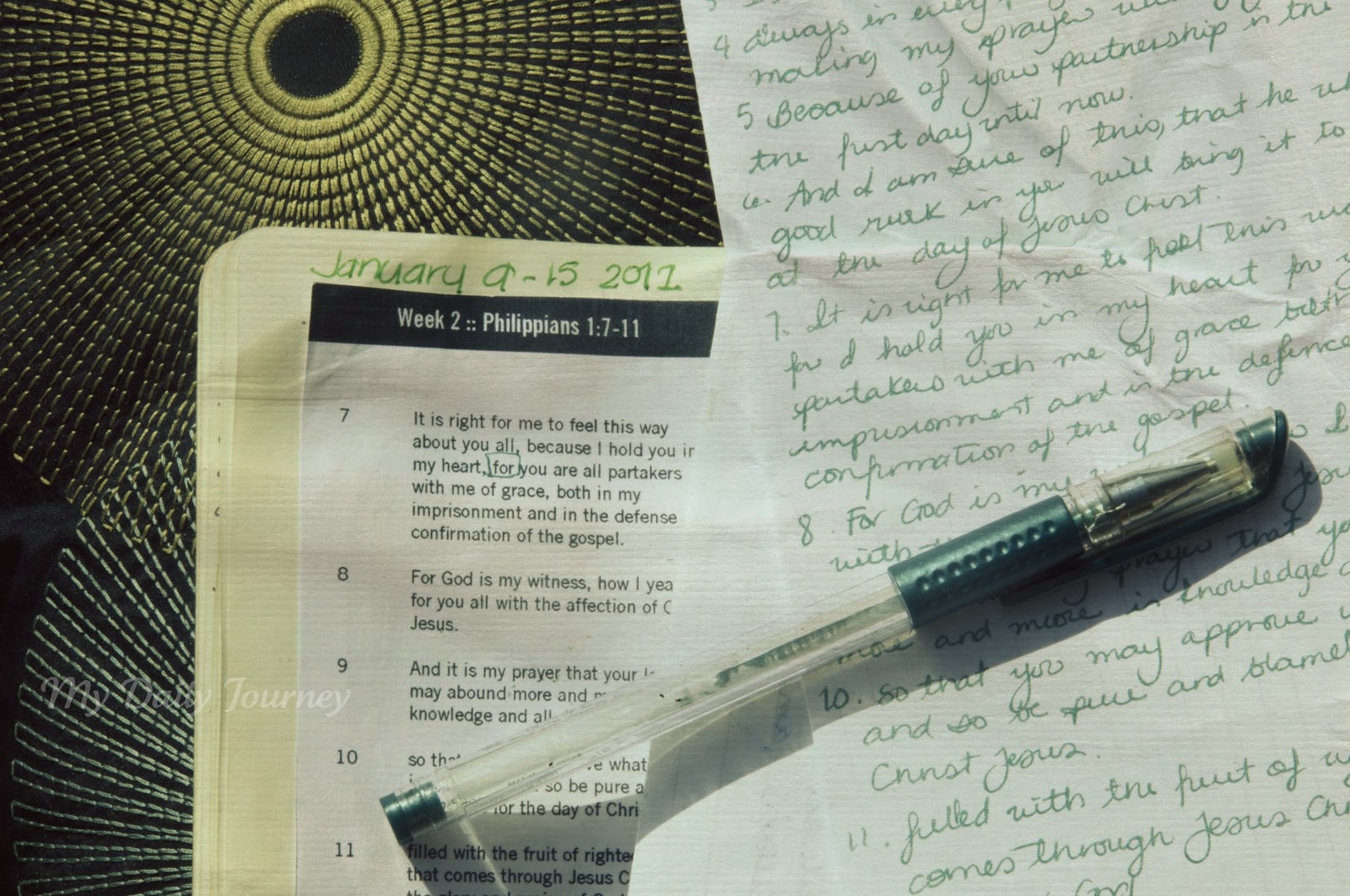
I walk into the kitchen, get the eggs and ham, count eight measures of coffee in the coffee maker, and pour the water… I mutter the verses; I stop, I pray. I look at the verses on the fridge; the smallest words are important, I can’t skip any of them. Prepositions are full of meaning; I don’t want to get them wrong.  My son comes in; he smiles at me, hugs me. I am so happy that he will grow remembering  his mom muttering the Word, chewing it, bite after bite; tasting it slowly.

Few of my reflections are here:

v. 1 Paul and Timothy servants of Christ Jesus.… O that I may introduce myself like this; not as “Daughter of the King”, but as a servant of Christ Jesus.

v. 2 Grace to you and peace from God our Father and the Lord Jesus Christ… The only way for us to have grace and peace is through God, we cannot find them anywhere else.  For us to have these two things, grace and peace, Jesus had to go the cross. We cannot say we have grace and peace without looking at the cross; it is there where we find them.

v. 3.- 4 Eucharisteoto give thanks– Thanks for all my remembrance of the saints; always in every prayer with joy…

Joy…
Joy in my prayers
Joy in giving thanks.
Joy in the intercession.

v. 5 How do I partnership in the gospel with those who Servants of Christ who are in need? The Philippians gave money and supported  Paul in a real way. What about me?

v. 6 Joy again. He who began a good work in me, in my husband, in my children will bring it to completion at the day of Jesus Christ! Grace called me and through Grace I will walk in my sanctification daily… until the day of Christ Jesus.

v. 7 I can not repeat this verse without praying for the saints who are today being persecuted. It is my desire to be partakers with them, so I think one tangible way of  becoming partaker with them is through this organization.

v. 8 God is my witness of all my longings, my yearnings, my heart’s desires, my emotions. He is witnessing every single thought that lies deep within my heart.

v. 9- 11 This has been my prayer these  two weeks… Lord, that I may abound in love with knowledge and all discernment; I repeat the Word, each Word… I pray. I mediate.
What for? 
Why would I want to abound in love?
That I may approve what is excellent.
Why do I want to approve what is excellent? 
So that I may be pure and blameless for the day of Christ,
filled with the fruit of righteousness that comes through Jesus Christ.
TO THE GLORY AND PRAISE OF GOD!

Yes! To give glory and praise to God is the chief end of man. I smile, I thank God, and keep on preparing our morning breakfast.

******************

Leslie Wiggins also shares her reflections on P2R week 2, here.
Aaron Armstrong is one week ahead and he shares his reflections here
My friend Anne in Europe is in this too, read her thoughts here. 

A suggestion:
I bought John MacArthur’s Commentary on Philippians and I am reading his commentaries on the verses of the week. It has proved to be an amazing blessing.

Maybe you are in this project too or are memorizing other parts of the Scripture, would you mind sharing your thoughts with us today?

>HOPE… A Precious Promise

>

These are some of the lines I have highlighted on Romans by R.C Sproul.

The only difference between hope and faith is that faith looks to what has already taken place, and we put our trust in it. Hope is merely faith looking forward” 

Hope is the anchor that keeps us from being blown all over the place. It is the hope that God is going to do in the future every single thing he has said he will do. The fruit of justification is that kind of hope.”

“Hope is not taking a deep breath and hoping things are going to turn out all right. It is assurance that God is going to do what he says He will do…. It is the solid stability that anchors the soul.”


Lord,
We don’t know what lies ahead.
We can’t see beyond the moment we are living,
However, we can see YOU in your Word.
We can see the promises
that we have in Christ Jesus.
All Yes and Amen.
HOPE.
Hope is one of them.
No mountain will raise that you can’t  help us climb.
No valley is to deep where we can’t  see You.
No tomorrow is too uncertain
because You have been there.
Thank you, O God,
because You have justified us,
and in our justification we find
what we most desperately need:
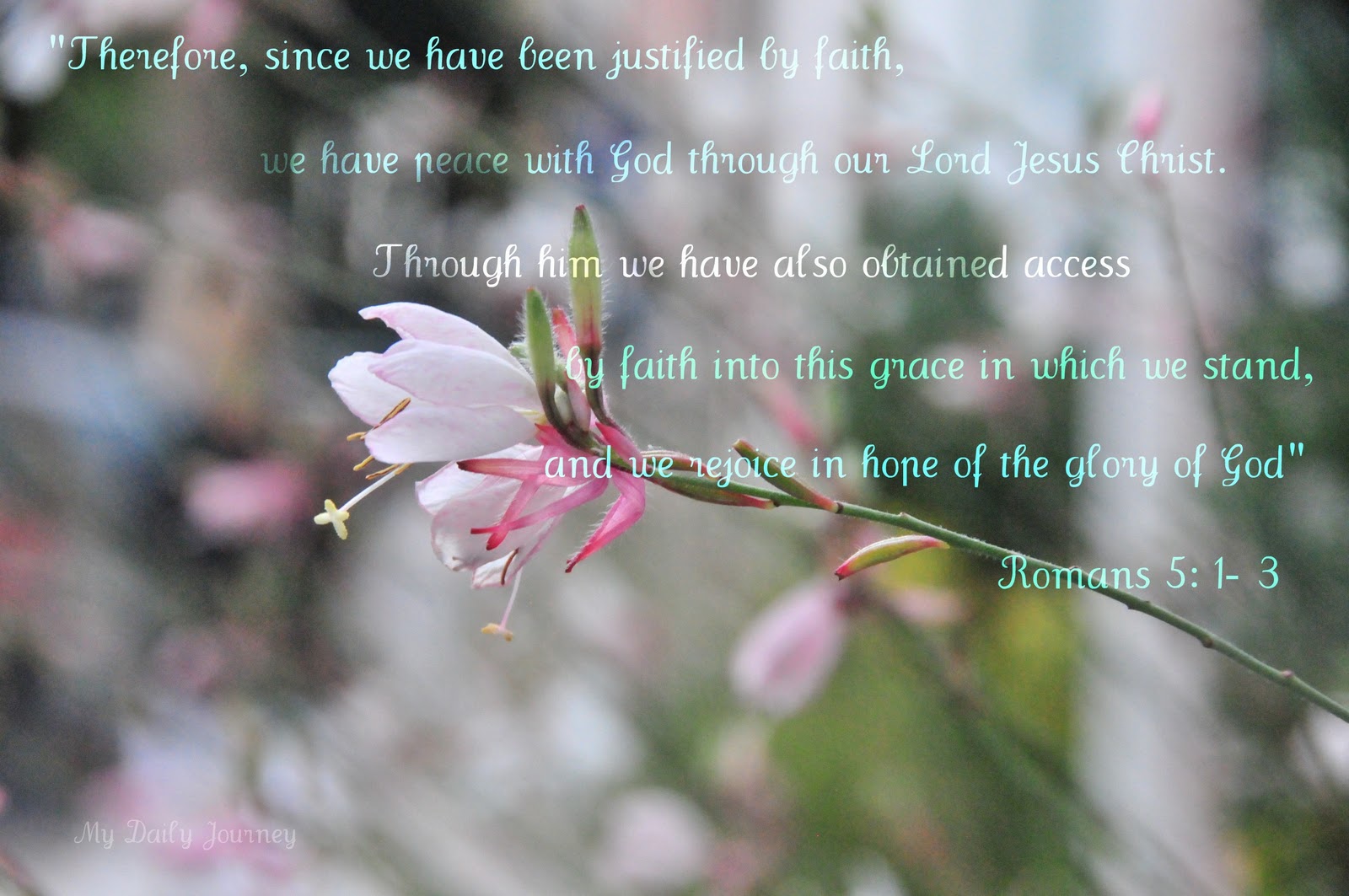
Peace with You through our Lord Jesus Christ;
Access by grace into this wonderful grace
in which we firmly stand,
and rejoicing in HOPE of the
glory of God.
*****************
Praying for you, that your life may be anchored in that solid stability:
HOPE


>Time to Study Philippians -Week Eight-

>p.MsoNormal, li.MsoNormal, div.MsoNormal { margin: 0cm 0cm 0.0001pt; font-size: 12pt; font-family: “Times New Roman”; }h1 { margin: 0cm 0cm 0.0001pt; page-break-after: avoid; font-size: 12pt; font-family: “Times New Roman”; }span.Ttulo1Car { font-weight: bold; }div.Section1 { page: Section1; }

Greetings to the ladies of our Philippians study~
Welcome to Week Eight – our final week!
This study, and the homework from our previous study, is a condensed version of Mining God’s Word – How To Study the Bible; Foundation Series by Bethlehem College and Seminary Press. I highly recommend that you purchase your own workbook at www(dot)bethlehemcollegeandseminary(dot)org – it would be a great tool for you to have.

“The angel answered, ‘The Holy Spirit will come upon you, and the power of the Most High will overshadow you. So the holy one to be born will be called the Son of God. Even Elizabeth your relative is going to have a child in her old age, and she who was said to be barren is in her sixth month. For nothing is impossible with God.’
             ‘I am the Lord’s servant,’ Mary answered. ‘May it be to me as you have said.’ Then the angel left her.” Luke 1:35-38

May our spirits be as willing as Mary’s when God calls on us!
Let’s start with our homework assignment #1
Here is what I have written for the main point of Phil. 3:1-16:
            All of Paul’s abundantly Jewish heritage and his qualifications as God-fearing Jew won’t save him – only Christ and His righteousness can! Therefore, Paul’s hope rests in Him and Him alone. To have Christ, or to belong to Christ, is more valuable than any else this life has to offer.

Homework assignment #2

The main point of Phil. 3:17 – 4:9

            Paul encourages the Philippians to follow his example in Godly living – to put it into practice, because they belong to God’s kingdom. He also is very bold with them by repeating his commands to rejoice, to have unity, and to stand firm. He also commands them to train their thoughts to be Godly.
I had also asked you to read through the entire book of Philippians and record all the instances where joy, or rejoice is found. Whose joy? Why is there joy? etc.
Here is my list of the joy theme:
1:4 – joy – Paul has joy while praying because of their partnership in the gospel
1:18 – rejoice  – Paul rejoices because the gospel is proclaimed
1:18 – rejoice – Paul continues to rejoices because of the hope of his deliverance (future-looking)
1:25 – joy – refers to the Philippians’ progress and joy in the faith.
2:2 – joy – Paul’s joy will be complete when they are like-minded; live in unity
2:17 – rejoice – Paul will rejoice with the Philippians, even while in chains, when they stand firm, so that all his labor with them has not been in vain. 
2:18 – rejoice – Philippians should rejoice with Paul whether or not he is suffering
2:28 – rejoice –Philippians to rejoice upon seeing Epaphroditus again (don’t hide their feelings from him)
2:29 – joy – the Philippians are to have joy and honor men like Epaphroditus.
3:1 – rejoice – Paul tells them to rejoice “in the Lord”. Don’t get side tracked by the circumcision laws.
4:1 – joy – Paul refers to the brothers as his “joy and crown” (Isn’t nice to know when we give someone else joy?)
4:4 – rejoice – Paul is commanding them to rejoice, again and again. Don’t stop rejoicing! Be anxious for nothing…
4:10 – rejoiced – how Paul felt or reacted when the Philippians were able to renew their concern for him.
For the Written summary of the theme of joy, I would like to quote directly from the Mining God’s Word workbook (pg. 93) because what the authors’ have said is excellent, and worth having you read:

The theme of joy in Philippians is striking for several reasons. First, it is clear that joy can survive and even flourish in the context of suffering. Paul rejoices despite those seeking to afflict him (1:18); he rejoices even though he is being poured out as a drink offering (2:17); he commands the Philippians to rejoice even thought hey are suffering (1:29). Second, it is striking that joy is commanded. This is a repeated and emphasized injunction of the letter (2:18, 3:1, 4:4).

It is assumed that the Philippians have the capacity to obey Paul’s command. Third, Paul places joy at the center of Christian life. He will continue his ministry to the Philippians for their “joy in the faith” (1:25), he sets himself up as a model of joy (2:17 – 18), and as we already stated, he repeatedly command s the Philippians to rejoice. Fourth, seeing joy cannot be an impure pursuit because Paul desires it (2:2) and sends Epaphroditus for the joy of the Philippians (2:28), and unabashedly commands it. Fifth, and most importantly, joy is rooted in God. Paul uses the phrase “rejoice in the Lord” three times (3:1, 4:4, 10). Although the Philippians are often what prompts Paul’s rejoicing (whether it be their partnership or faith or help), the context of the letter makes it clear that Paul’s rejoicing is over the way in which God is being exalted in them as a work of grace (1:6, 2:13). So at every turn Paul shatters the common ideas about joy. Joy can exist in the midst of suffering, it can be commanded, it is at the center of Christian life, it should be pursued, and it is rooted in God alone.

Isn’t that a fabulous summary?
For today’s class, I will attempt to wrap up the rest of Philippians (4:10 –23). Please read these verses now and then come back.
OK, here is my summary:
Paul tells the Philippians that he rejoices greatly in the Lord and then explains why. He wants no misunderstanding between them. He acknowledges that they have always cared for him even though they may not have had the financial means to do so.  He seems to draw similarities between ‘being in need’ and also ‘having all of his needs met’, by the fact that he always relies and trusts in God no matter what circumstances God has placed him in. A sign of true contentment – an example he wants them to imitate. However, he wants them to know he is grateful and thankful that they remembered him and blessed him. He even calls to mind how many times in the past they have come to his aid. He equates the ‘fragrant offering’ that is acceptable to God, to the pleasing aroma of the OT sacrifices that were also acceptable to God. He reminds them that, as God has supplied his needs through them, that God will also supply their needs. He draws to a close with a Doxology (a liturgical expression to praise God), and then sends the final greetings from the saints with him, making a special point of mentioning the saints within Caesar’s household. This is a rather bold statement that lets the saints at Philippi know that the gospel message had spread even into Caesar’s household! Nothing can thwart the movement of the spirit of God.
That’s it. We’re finished with Philippians. Do you know more about the book of Philippians than when we started 8 weeks ago? Can you explain the reasons why Paul wrote this letter to the Philippians? Is being in prison a blessing or a curse? Can it be both?  Should it be both? Should we allow doubts/controversies into our hearts that are different from the gospel? Do we need more than Christ and His love and sacrifice to make our lives complete? Are your thoughts aligned with Christ Jesus? Do you want to be remembered as a Godly woman or one who is chastised for bickering? Can you grasp the idea of joy as a command? Is joy another emotion, like anger, that can come and go, or is it a reflection of the Holy Spirit living within each of us? (“The fruit of the spirit is love, joy, peace, patience, kindness, goodness, faithfulness, gentleness, and self-control.” Gal. 5:22)
Thank you for working through this Epistle with me. I have enjoyed the time thinking through Paul’s teachings while writing it down for you. It has solidified what I already know, and reminded me of things I had forgotten.  May God be honored and praised by our lives from this day forth. Remember, the gospel of Christ is tidings of comfort and joy.
Blessings on your homes! Bye, bye~
Yours sister in Christ,
Eileen

>Time to Study Philippians -Week Seven-

>@font-face { font-family: “Wingdings”;}p.MsoNormal, li.MsoNormal, div.MsoNormal { margin: 0cm 0cm 0.0001pt; font-size: 12pt; font-family: “Times New Roman”; }h1 { margin: 0cm 0cm 0.0001pt; page-break-after: avoid; font-size: 12pt; font-family: “Times New Roman”; }p.MsoBodyTextIndent, li.MsoBodyTextIndent, div.MsoBodyTextIndent { margin: 0cm 0cm 0.0001pt 72pt; text-indent: -72pt; font-size: 12pt; font-family: “Times New Roman”; }span.Ttulo1Car { font-weight: bold; }span.SangradetdecuerpoCar { }div.Section1 { page: Section1; }ol { margin-bottom: 0cm; }ul { margin-bottom: 0cm; }

Greetings to the ladies of our Philippians study!
Welcome to Week Seven~
This study and the following two weeks of lessons will be a condensed version of Mining God’s Word – How To Study the Bible; Foundation Series by Bethlehem College and Seminary Press. I highly recommend that you purchase your own workbook at www(dot)bethlehemcollegeandseminary(dot)org – it would be a great tool for you to have!
“And Jesus increased in wisdom and in stature and in favor with God and man.”                                 Luke 2:52
Let us review our homework first:
Did you manage to find references to “fellow worker(s)”? I will list a few of mine below for you. Most likely you will have come across some of these also. Please read the verses around these texts to know the context.
Romans 16:3 – “Greet Prisca and Aquila, my fellow workers in Christ Jesus…”
            The fellow workers listed here are a man and a woman. A church met in their home (16:5).
Phil. 4:2-3 – “Yes, I ask you also, true companion, help these women [Euodia and Syntyche], who have labored side by side with me in the gospel together with Clement and the rest of my fellow workers, whose names are in the books of life.”
            Referring to men and women as fellow workers.
1 Cor. 3:9 – (beginning in verse 8) “He who plants and he who waters are one, and each will receive his wages according to his labor. For we are God’s fellow workers.”
            This text is talking about what Paul and Apollos have individually done for the church body. Do not think one is better than the other.
Col. 4:11 – “ …These are the only men [vs.10] of the circumcision among my fellow workers for the kingdom of God, and they have been a comfort to me.”
            These men are Paul’s comfort and support during this time.
Philemon – 1:1 “To Philemon our beloved fellow worker…”
            We know that Philemon had a house church where the saints gathered together.
Phm. 1:24 – “…and so do Mark, Aristarchus, Demas, and Luke, my fellow workers.”
            Paul is sending greetings from these men back to Philemon along with others mentioned in the verses before this one.
2 Cor. 8:23 “As for Titus, he is my partner and fellow worker for your benefit.”
            Titus was a leader and a teacher.
There are more than this listing, but these will give us a good foundation. What were you able to learn about “fellow workers”? They could be both men and women; they were more than just Christians in the first century, they were ones who labored close to Paul, striving for the kingdom of God. Many were church leaders, or had churches meeting in their homes. (However, it was not a church office.) They were held up as examples, and Paul often requested on their behalf, for the saints to comfort and refresh them, since many of them also traveled to comfort and encourage Paul.

Main point of Philippians 2:19-30

Paul is sending Timothy and Epaphroditus and back to the Philippians. Timothy is known for his love and service to Paul and his love for the Philippians. Epaphroditus, being the Philippians’ minister and messenger, is returning so they no longer have concern for his safety or his health. He went through many trials to be with Paul and he deserves their honor also.
For Today: 
Since this eight-week study is a condensed version of a twelve-week study, I will need to blend some chapters and homework together, so that we may finish the first week of December. Therefore, I am going to assign homework for you now, and then give you a bit more after I finish today’s lesson.  
Homework part 1 – Read all of Philippians and then re-read Phil 3:1-16. Write down your observations (remember “pointer” words), and then give me a short summary of Phil. 3: 1-16.
Today’s lesson:
Bible Genres – By definition, a genre can be a literary work characterized by its form, content, or style. The Bible contains eight main genres:
1)    Historical Narratives – these contain stories with specific time/place and events mentioned, and usually have a beginning, middle and an end. 
2)    Law – writings that have the commands of God and tell the people how to act according to His decree.
3)    Prophecy – God’s messengers calling the people/nation to obedience of His word. Can contain future judgments. 
4)    Poetry – a writing style that is figurative, has parallelism and uses language with vivid imagery.
5)    Proverbs – short, memorable sayings that portray truth and yet also have a bit of a sting or bite to them. Contain great wisdom.
6)    Gospels –writings that join together biography (of Jesus) and theological teachings.
7)    Parables – stories or statements that portray life; those listening recognize they are to do something with the information of the story.
8)    Epistles –written with a specific audience in mind (like the letters to the Philippians) but can be used today to glean wisdom and knowledge of Godly living. The epistles are generally a one-sided conversation, since they were written in response to an event.
With these eight genres in mind, I am going to write a few verses, but not tell you where they are located. Are you able to recognize which Book I’m quoting out of? Can you figure out the genre? I will write the correct answers at the end of all these verses. Try not to peek at the answers first. J
1)“But as for me, my prayer is to you, O LORD. At an acceptable time, O God, in the abundance of your steadfast love answer me in your saving faithfulness. Deliver me from sinking in the mire; let me be delivered from my enemies and from the deep waters. Let not the flood sweep over me, or the deep swallow me up, or the pit close its mouth over me. Answer me, OLORD, for your steadfast love is good; according to your abundant mercy, turn to me.”
2) “So the LORD sent a pestilence on Israel from the morning until the appointed time. And there died of the people from Dan to Beersheba 70,000 men. And when the angel stretched out his hand toward Jerusalem to destroy it, the LORD relented from the calamity and said to the angel who was working destruction among the people, ‘It is enough, now stay your hand.’ And the angel of the LORD was by the threshing floor of Araunah the Jebusite. Then David spoke to the LORD when he saw the angel who was striking the people, and said, ‘Behold, I have sinned, and I have done wickedly. But these sheep, what have they done? Please let your hand be against me and my father’s house.’”
3) “Even a child makes himself known by his acts, by whether his conduct is pure and upright. The hearing ear and the seeing eye, the LORD has made them both. Love not sleep, lest you come to poverty; open your eyes, and you will have plenty of bread. ‘Bad, Bad,’ says the buyer, but when he goes away, then he boasts. There is gold and abundance of costly stones, but the lips of knowledge are a precious jewel.”
4) “A man planted a vineyard and let it out to tenants and went into another country for a long while. When the time came, he sent a servant to the tenants, so that they would give him some of the fruit of the vineyard. But the tenants beat him and sent him away empty-handed. And he sent another servant. But they also beat and treated him shamefully, and sent him away empty-handed. And he sent yet a third. This one also they wounded and cast out. Then the owner of the vineyard said, ‘What shall I do? I will send my beloved son; perhaps they will respect him.’ But when the tenants saw him, they said to themselves, ‘This is the heir. Let us dill him, so that the inheritance may be ours.’ And they threw him out of the vineyard and killed him. What then will the owner of the vineyard do to them? He will come and destroy those tenants and give the vineyard to others.”
5) “And she has rebelled against my rules by doing wickedness more than the nations, and against my statutes more than the countries all around her; for they have rejected my rules and have not walked in my statutes. Therefore thus says the Lord GOD: Because you are more turbulent than the nations that are all around you, and have not walked in my statutes or obeyed my rules, and have not even acted according to the rules of the nations that are all around you, therefore says the Lord GOD: Behold, I, even I, am against you. And I will execute judgments in your midst in the sight of the nations. And because of all your abominations I will do with you what I have never yet done, and the like of which I will never do again.”
Answers:
1)    Ps. 69:13-15. Poetry. Vivid imagery. Parallel theme of deliverance in the plea.
2)    2 Sam. 24:15-17. Historical Narrative. There are names/places mentioned and a story line.
3)    Pr. 20:11-15. Proverb. Short sentences. Many with contrasts between folly and wisdom.
4)    Luke 20:9-16. Parable. Introduction is the beginning of a story. No one specifically is named. The hearers are to respond.
5)    Ezek. 5:6-9. Prophecy. Judgment from the Lord because of lack of obedience.
I did not cover all the genres, but the rest are easy to recognize. How did you do? Did you recognize any of the books these verses came from?
Once we understand the genre of a book, it will be easier for you to interpret the writing of a book. (Many books do contain more than one genre. Luke is a gospel, but the part I quoted was a parable within the gospel.) Again, ask God for wisdom.
Which category does Philippians belong to? It would be an epistle because it is a letter to specific people, and it is only one side of the conversation between Paul and the Philippians. We can, therefore, make certain estimations or educated guesses about what may have happened in the past by what Paul is addressing in his letter.

Homework part 2 –

Read Philippians 3:16-4:9. Re-read it slowly, watching for ‘pointers’ and making notes on what you observe. Then write down your summary of the main point.
Read the entire book of Philippians looking for themes of JOY. It can be joy, or rejoice, or rejoicing…anything along those lines. Make a list of all the references for JOY.
Using the first half of your list, write down the reasons for the joy and who’s joy it is.
Now, do the same for the second half of your list, again writing down the reasons for the joy.
Write a summary of what you think about JOY in the book of Philippians. Do you understand joy better for your life?
Have a blessed Thanksgiving week! We do have so much to be Thankful for! (How does the old hymn go? “Count your blessings, name them one by one. Count your many blessings, see what God has done…”)
We’ll meet back here the first week in December.
Again, Thank You Becky, you are a beloved sister!

Eileen

****************

Are you just coming in?

Welcome!

You can start this series today. Read the introduction here and the first week’s study here.

**********************

>Time to Study Philippians -Week Six-

>p.MsoNormal, li.MsoNormal, div.MsoNormal { margin: 0cm 0cm 0.0001pt; font-size: 12pt; font-family: “Times New Roman”; }div.Section1 { page: Section1; }ol { margin-bottom: 0cm; }ul { margin-bottom: 0cm; }

Greetings to the ladies of our Philippians study!
Welcome to Week Six~
This study and the following two weeks of lessons will be a condensed version of Mining God’s Word – How To Study the Bible; Foundation Series by Bethlehem College and Seminary Press. I highly recommend that you purchase your own workbook at www(dot)bethlehemcollegeandseminary(dot)org – it would be a great tool for you to have!

“You have turned my mourning into dancing; you have loosed my sackcloth and clothed me with gladness, that my glory may sing your praise and not be silent. O Lord my God, I will give thanks to you forever!” Ps. 30:11-12

Ladies, we only have a few weeks left of our study. I will be taking the week of Thanksgiving off (Nov. 22-26), so our last study will be the first week in December.
Our homework from last week:
Even though I asked you to write a few paraphrases throughout Philippians 2:12-18, I will combine all the paraphrases together for one final paraphrase of 2:12-18. Here is my example:
My beloved brothers, because of the excellent example of humility we have in Christ Jesus, and even though I am not with you now, I want you to continue to obey what you have previously been taught. Do this because you know that God is working in you, and it is for his good pleasure to do so. Do not whine and gripe about your circumstances like the non-believers do, but be different from them – set apart. They live in darkness not knowing Christ, but you do know Christ. Therefore, you are like bright lights shining into their sinful and darkened world. Do not waver in what I have taught you and what you know is true. Your faithfulness is important to me. Even if I should be killed for your salvation, knowing that you have remained firm in the truth of Christ Jesus would give me cause to rejoice.  So don’t lose heart, but rejoice with me.
Main point of Phil. 2:12-18  – 
Paul exhorts the Philippians to imitate Christ and live according to the Gospel Paul has taught them. To work out their salvation because God is working in them, even in the midst of their sufferings.
I presume your paraphrase will have parts that are similar to mine and part that are slightly different. That’s all right. Paraphrasing will be like that according to each author.
This week’s lesson:
We will be working with our concordances, and doing a few word studies.
Word studies are valuable tools for those studying their Bibles. They allow us to follow and clarify ideas, theology, and locate OT and NT teachings. However, there are also problems that arise when doing word studies. I am going to talk about three specific problems that you need to watch out for.
1)    Be careful when looking up words, that you do not assume the individual roots of a word combine together for a more accurate definition. Here’s an example: Butterfly. There are two words here, Butter and Fly. Now, we know what a butterfly is, and it is not butter that flies. So combining the meaning of the two root words, does not give us the correct meaning of the word they create together. 
2)    Be careful when looking up words that you do not assume that the meaning of a word is always the same, or close to the same, in each instance it is used. 
3)    Also note that the meaning of a word in a specific context may not be a sum of all its parts; a culmination of everywhere else it is used. Context is important.
With these few warnings to remember, let us begin to look up words in our concordance.
We will begin with the word Antichrist. First, what do you think “antichrist” means?
I would like you to look up 1 John 2:18, 1 John 2:22, 1 John 4:3, and 2 John 1:7 and write down what you observe about this word, the context it has been written in, and then summarize what you learned from the verses we looked up. Do this now, and then come back to class, and I will write down what I discovered.
1 John 2:18 – there are many antichrist, and more to come – that’s how the people in John’s time knew they were in the last hour. Contextually, we see that the antichrists were part of the church community, but left the fellowship of the believers. The Christians thought they (the antichrists) were saved also, but if they had been, they would not have ‘gone out’ from the believers, but they did, proving that they (the antichrists) never really belonged to Christ.
1 John 2:22 – the liar is the one who denies that Jesus is the Christ; he who denies the Father and the Son.
1 John 4:3 – every spirit that does not confess that Jesus Christ has come in the flesh is the spirit of the antichrist; the antichrist is already in the world.
2 John 1:7 – many deceivers have gone out into the world, those who do not confess the coming of Christ in the flesh. That one is the antichrist.
Summary about the antichrist: They (more than one) were in the world at the time of John’s writing. They were the sign of the appearance of the last days. They deny that Jesus Christ has come in the flesh, and they deny the Father and the Son. They teach opposite the truth (they left the company of believers).
Is this what you thought “antichrist” meant? Did you happen to notice that only John wrote about the Antichrist?
Let’s look up one more: Last Days
Here are the scripture verses for you to look up, record, and summarize your observations:
Acts 2:17; 2 Timothy 3:1; Hebrews 1:2; James 5:3; and 2 Peter 3:3.
My observations:
Acts 2:17 – Peter (at Pentecost) quotes from Joel 2:28-32 about the signs of coming of the Last Days; God pouring out His Spirit on all flesh. The signs of the Last Days were happening in Acts 2:17.
2 Timothy 3:1– in the Last Days there will be difficult times. People will be filled with sin (see the list in vs. 2-6).
Hebrews 1:2 –Last Days was a current time in the writer’s life (“these last days”).
2 Peter 3:3 – reminding the readers of what the prophets of old had predicted about the Last Days. The Scoffers will doubt and try to persuade others to doubt as well.
What did the prophets of old tell? They (Isaiah, Jeremiah, Hosea to list a few) talked of the sinful Israelite nation who turned away from their God. Therefore, God brought judgment down on them, being taken captive and other nations’ kings ruling over them (Assyria, Babylon, Persia). Now, in the NT, we have the last days of the same unbelieving nation. The Jews (Israel) did not believe that Jesus was the foretold Messiah. Therefore, God was showing them that their Jewish nation as they knew it, was at an end – the last days. God would destroy their temple (Matt. 24:1-2, read farther for context), which did happen in 70 AD, because His Son was the last sacrifice ever needed. The thing that made them Jewish – their worship, their sacrificial system, their works – meant nothing now that Jesus has come in the flesh. Remember what Paul said in Phil. 3:5-10?
Summary of Last Days:
The time between Jesus death and the destruction of the temple in 70 AD were the Last Days – the Last Days were happening while the author’s were alive.
Homework for this week:
Day 1) Let’s concentrate on Philippians 2:19-30, but pay particular attention to “Fellow Worker” in v. 25. Find each phrase “Fellow Worker(s)” in your concordance. Make a column (not very wide) down the left-hand side of your homework page. In this column, record all the Biblical references to the term “Fellow Worker(s)”, each reference on a separate line.
Day 2) Read the passages in Scripture for each of the references in the first half of your “Fellow Worker(s)” listing. Try to answer these questions while you’re reading: Is the Fellow Worker and man or a woman? Is this phrase referencing a particular job within the church? Are there other words that always appear in conjunction with the term “Fellow Worker”? What is the context that this phrase appears? Record your answers to these questions in the right-hand margin next to that particular Scripture verse.
Day 3) Repeat yesterday’s instructions with the second half of your concordance list of “Fellow Workers”.
Day 4) Write down what you think the term “Fellow Worker(s)” means, or was used for, in the NT. Re-read Phil. 2:25. Does your new knowledge of Fellow Workers increase your understanding of the text?
Day 5) Write down what you think is the main point of Phil. 2:19-30.
And we’re finished with this week! The last two weeks of class we will cover more of the text than in the previous lessons, so that we can get through the entire book of Philippians before ending our class.
Ladies, may you be filled with more than knowledge, but with wisdom that can only come from our Father in heaven, as you read and study the Scriptures. Becky, once again THANK YOU for allowing me the time and the space on your blog to post our study.
Praise God from whom all blessing flow,
Eileen
 ***********************
 Related Posts: