>On Imperfections, Cracks and the Gospel -P2R week 5-

>

“Only let your manner of life be worthy of the gospel of Christ, so that whether I come and see you or am absent, I may hear of you that you are standing firm in one spirit, with one mind striving side by side for the faith of the gospel, and not frightened in anything by your opponents. This is a clear sign to them of their destruction, but of your salvation, and that from God. For it has been granted to you that for the sake of Christ you should not only believe in him but also suffer for his sake, engaged in the same conflict that you saw I had and now hear that I still have.” Philippians 1: 27- 30 ESV

I repeat these words several times a day, it’s week 5 of the P2R project; and I just can’t do it fluently. I stop and see my imperfections, the cracks in my own life. I not always live my days, my minutes worthy of the gospel of Christ. The Holy Spirit reminds me of some hidden sins in my heart (some of omission). The light of the Word pierces into those corners of my life where darkness has found a place; God grants me the gift of repentance and darkness is overcome. Sanctification is a gift from God; the Father has not only called us to be His own and justified us; but He is working in us day by day; His Light piercing the darkness in our hearts. This is the Gospel, good news for sinners who repent and believe in Him who on the Cross conquered death. (And here I would add… If you don’t read your Bible, if you don’t expose your soul to the Light, how would you expect to grow in Him?)

What are those words that come next? “…It has been granted to you that for the sake of Christ you should not only believe in Him but also suffer for His sake”  Why they can’t be found in a “Book of Promises”?

At the table I tell my children and my Beloved, with a lump on my throat, “I have never suffered for the gospel… I pray, O how I pray, that if such a day comes to me; I will be joyful, and count it as a blessing, as gift granted by God.”

I mutter all the words in chapter one; and I can clearly see that the only way for me, for you, to count every trial, every suffering as a gift from God is to live beyond the time line in which we are bound. We must live with our eyes fixed on Jesus; longing to be with Him…“for that is far better”, far better than anything this world could offer us; far better than anything we could have ever imagined!

Under His Sun and by His grace,

Read my friend Anne’s reflections on her memory project here.
and listen to Aaron recite chapter one here.
Be encouraged, dear friend, you can start today! Read about P2R here.

This post is linked to the photography {word} prompt at Three.

>Prokop (Progress) – P2R Week 3-

>

I am very happy to be part of the huge number of saints memorizing Philippians (P2R). I am studying along a commentary on Philippians by MacArthur ; which has proved to be something beneficial for my soul. So just as I did last week, I will post some interesting insights I have gleaned from these verses.

Prokop is the greek word that means progress; advance.  Definitely a key word on this week’s memory verses (Philippians 1: 12- 18).

Every trial in the life of the Christian should serve to advance the gospel. “It was the progress (the advance) of the gospel for which Paul lived so passionately” (emphasis mine) It was this way of living through trials that make him write the Epistle of Joy!

“One of the surest measures of a Christian’s spiritual maturity is what it takes to rob him of his Spirit-bestowed joy. Paul’s maturity is evident in the present text as he makes it clear that difficult, unpleasant, painful, even life-threatening circumstances did not rob him of joy but rather caused it to increase.”

Philippians is known as the Epistle for joy, but we know that joy is not always present in the life of the believer; why? MacArhur says,

“The only certain cause for loss of joy in a believer’s life is sin, which corrupts his fellowship with the Lord, who is the source of joy. Such sinful attitudes as dissatisfaction, bitterness, sullenness, doubt, fear, and negativism cause joy to be forfeited. Consequently, the only way to restore lost joy is to repent and return to proper worship of and obedience to God.
Any thing other than sin -no matter how difficult,  painful, or disappointing- need not to take away the believer’s joy.”

This is a time to stop and ask ourselves, how do we react to those hard circumstances in life that we encounter? Paul was in prison, his circumstances were terrible, however, he rejoiced because he knew that he was put there for the defense of the gospel; he knew he was in prison with a  God- glorifying purpose, the advance of the gospel.

I have friends (for example Hollie and Persis) who have gone through very harsh times and have learned to give glory to God in the midst of their circumstances and have fought against their flesh to keep their joy. This humbles me and I learn from them.

“He {Paul} did not ignore or make light of his imprisonment (cf. 1:7,14, 17; Col. 4:3, 18; Philem. 9, 13), but it was incidental to his willing, joyous, and immeasurably privileged status as a bondservant of Jesus Christ (1:1)… Everything in Paul’s life had  importance only to the degree that it affected the progress (the advance) of the gospel.” (Emphasis mine)

So no, we are not to “confess” the opposite of what is happening, of the reality God has brought to our lives; but we must see beyond it!

Now, what is our reaction to the trials our  brothers and sisters in Christ are walking through? Paul says that many brothers became more confident in the Lord by his imprisonment  and spoke more boldly the word without fear (v. 14). To this MacArthur says,

“His strength became their strength, as his example touched them… courage is contagious”

Isn’t this a wonderful example on how all that happens to us serves to advance the gospel if we give God the glory due to His name in all? I am thinking of this, if a Christian complains all through the period of trial he has to go through, then no one around him will be encouraged to walk with confidence before a sovereign God; so next time I walk through trials, I want to be an encouragement to the saints around me, always giving God the honor and speaking boldly the word without fear.

The last quote I want to share now is this:

“Absolutely nothing could steal Paul’s God-given joy. He was expandable; the gospel was not. His own privacy and freedom were incidental, and he cared nothing for personal recognition or credit. Neither the painful chains of Rome nor the even more painful criticism of fellow Christians could keep him from rejoicing, because Christ was being proclaimed and His Church was growing and maturing”

Today I am grateful for the Epistle to the Philippians. There is so much to learn.. !

May we be willing to live passionately to advance the gospel of Christ through all the circumstances we walk through.

Some friends Memorizing Philippians share their thoughts (I encourage you to visit them):

Read my friend’s Anne’s reflections here.
Aaron  @Blogging Theologically shares his thoughts  here. 
Leslie Wiggins’ reflections are here

What have you learned through this week’s verses? Any helpful tips? Any insights you want to share? 

Join the conversation!

***********************

>Persevering Prayer – Living in the Sacred-

> When I wrote about my year’s theme, Living in the Sacred,  a visitor left a note saying, “It will be interesting to see how you live it out and communicate it on here this year.”

I don’t know if you are still sojourning with me, dear visitor,  but I want to say that Living in the Sacred is real, is what we Christians do, every day, every moment. It is not something I made up; it is not something mystic, it is REAL. We live in the Sacred, because we live in Him.

“In him we live and move and have our being” Acts 17: 28

My dear friend, Living in the Sacred, living in Him, is living in prayer, in communion with Him…. always praying; praying without ceasing.  It is abiding in the Word, because it is in the Word of God where we can clearly hear His voice.

This is what I don’t want to forget this year, this life I live under His sun and by His grace.

Today’s borrowed words are taken from Grace Gems, (I know it is long, but I encourage you to read it all)

“The exhortation, then, of the apostle, to the Philippian Church, means, first, that prayer should be the pervading spirit of the Christian life—that it should be, as leaven, fermenting the whole substance of our moral being—a sentinel, continually keeping watch over our unguarded movements—a sanctified enclosure, fencing us round by the protection and presence of God. Like those bright and glorious orbs which revolve in the skies above us—no sounds may be uttered—but the language of the heart unceasingly ascends to the Father of spirits, and enters into the ears of the Lord God Almighty. There may be no form—no utterance of language—it may be a tear—a sigh—a wish—a hope—a desire—a groan—but the whole Christian life is pervaded by the spirit of prayer.
“Prayer is the soul’s sincere desire,
Uttered, or unexpressed—
The kindling of a hidden fire 
That trembles in the breast.
The formation of plans—the carrying on of daily duty—the going forth to encounter any difficulty or trial—the bearing up under reproach, injury, or wrong, are all thought of, in subjection to the will of God, in prayer. The Christian man will not absolutely say, “I will do,” “I will not do,” until he has thus committed the matter, in prayer, to God. It fills his heart as he opens his eyes to another day—and, a silent prayer is breathed, that its dangers may not injure his soul—that its good may be received with thankfulness, and its evils may be averted or shunned. It enters into all his hopes and desires, so that they are always, “If the Lord will.” When an evil thought rushes into the Christian’s heart, it finds that the spirit of prayer is there to meet it—when a subtle temptation creeps stealthily through the soul, if it has been thus exercised, there is comparatively but little upon which it can lay hold, and it retires without having drawn him into sin. It is thus that he realizes prayer as a perpetual safeguard against the attacks of the adversary; and, living under its sacred influence, he has the blessed consciousness of living near to God. God dwells in him, and he in God—the Divine image is reflected upon his soul, for “God is light, and he who dwells in light, dwells in God and God in him.”
Under all circumstances and in all conditions, this spirit of silent, yet earnest, believing prayer, may have its power upon the heart. Its home is the Christian’s bosom—its hallowed influence pervades the Christian’s life—it brings down the happiness and peace of heaven itself into the Christian’s soul, so far as these can be enjoyed in this imperfect state of being; and, it is, in truth, the most elevating, comforting, and transforming, of all the duties, in which the Christian can engage on earth. It brings him nearest to his God, and his God to him. There are no circumstances in which it can be crushed—no peculiarities of place in which it may not be indulged. In the time of adversity—when earthly blessings are removed—this spirit sustains the soul, by leading it to “cast all its care on God who cares for it.” In the hour of bereavement—when the home is desolated and the heart is wrung—this spirit calls Jesus to look upon the desolated home and the torn heart, and reminds Him, that when on earth, He once shed a tear over a scene like this; and, there is no thought of a removal of the sorrow, except by the spirit of prayer, which can alone cope with the sad, desolating power of grief.
*******************
“[W]hile the Christian may thus, in everything, hold sweet, unbroken communion with heaven—and, through all the duties and trials of daily life, may cherish and retain the spirit of prayer—he will have his special sacred times with God. Times of meditation and prayer—times which only sickness or imperative necessity will ever permit him to invade or to interrupt—times when the world and the things of the world are forgotten, and the soul draws fresh nourishment, and strength, and hope, from pouring out its desires and longings—its supplications and entreaties, at the throne of grace, and, anew, asking help against coming toils and trials, from its gracious and compassionate Heavenly Father.”

********************

“[T]he exhortation of the apostle goes even further than this, and implies that, in every condition and circumstance of life, Divine guidance, and help, and counsel, should be sought in prayer. There are many, who flee to a Throne of Grace in times of extremity, but who are strangers to it when all is calm and tranquil—who never imagine that the help of God is needed quite as much in prosperity as in adversity—in health as in sickness. “When trouble is upon them,” says Scripture, “they will pour out their souls unto God.” “In their affliction they will seek me, says the Lord.” Yes, they know they cannot, in such trying circumstances, bear up without the help of Heaven—they feel the utter insufficiency of human resources, and the weakness of human trust—and they cry unto the Lord for help. They pray in the tempest, but are silent in the calm—they implore deliverance from the sick-bed, but not the fear and love of God to keep and guide them in the day of health—they make their complaint under the pressure of calamity, or the burden of distress, but they ask not for a thankful spirit in the midst of their plenty and prosperity.”

*********************

“The true Christian, however, realizing his own feebleness and his entire dependence on the grace and help of God—”in everything makes known his requests unto God”—not merely in times of tribulation, when the storm has driven him to seek for shelter—not merely in days of sickness and trouble when he stands as it were on the brink of death’s dark flood—but when everything is bright and prosperous, and when health and vigor animate his frame. If in sickness, he prays for patience—in health, he prays for a thankful spirit. If in adversity, he prays that God may not forget him—in prosperity, he prays that he may not forget God. He makes known his requests, not merely for spiritual, but for temporal blessings, knowing that his temporal and spiritual lot are inseparable, and that, in the arrangements of both, he cannot and ought not to rely on his own judgment and discretion, but on the gracious promise of God—”In all your ways acknowledge Him, and He shall direct your paths.”

You can read the whole article here.

So Dear Reader, I am living out this year’s theme by learning to fill my days with prayers. I am learning to “retain the spirit of prayer” in the midst of my duties and while hugging and kissing my children and husband; I am learning to have “special sacred times with God” throughout my day; times of  prayer, times of meditation on His Word while memorizing it, because I long to abide in Him all day long.

May God help us to  persevere today in prayer, to live with our heart inclined to prayer.

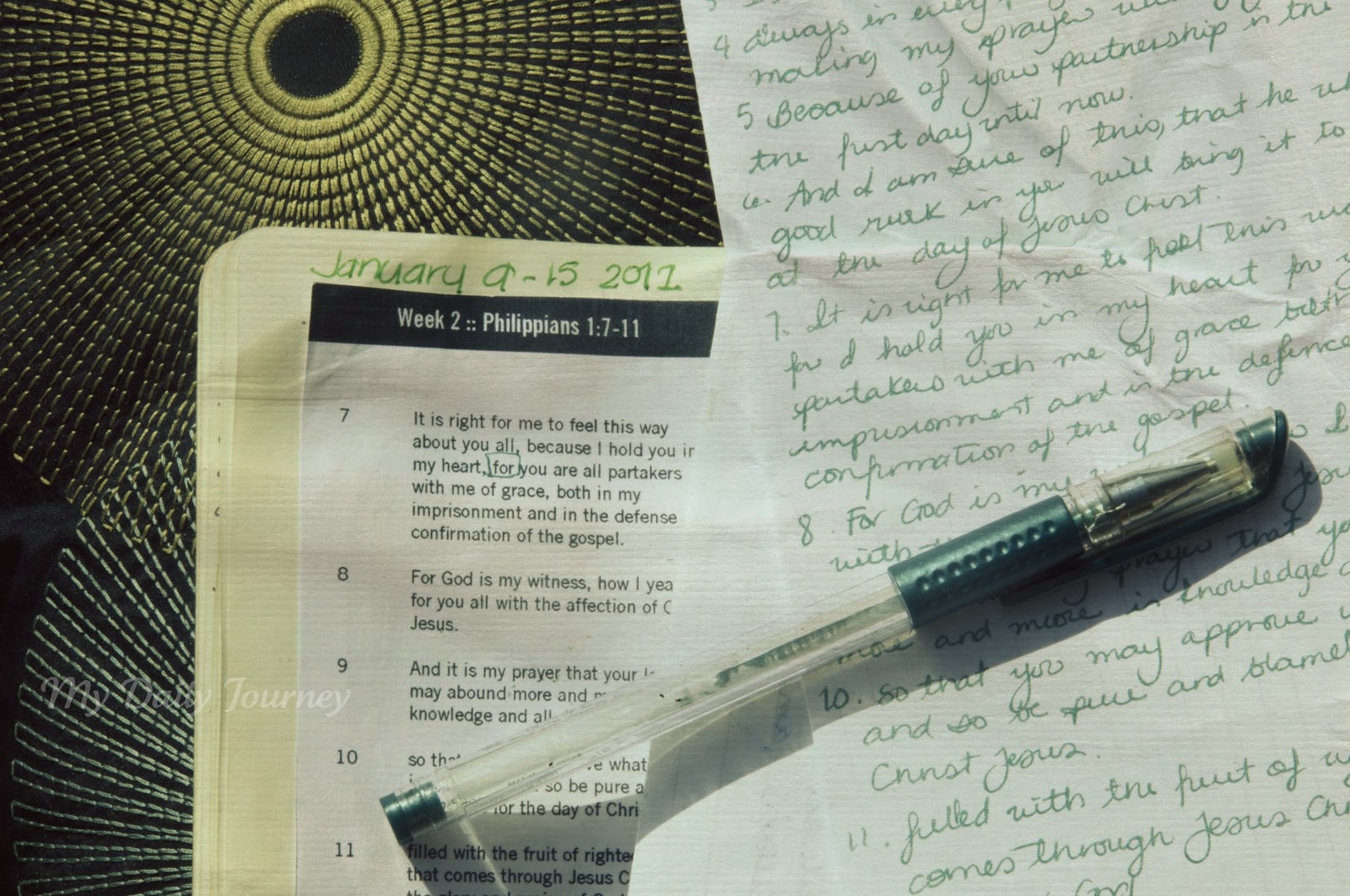
>Eucharisteo -P2R Week 2-

>

We are just finishing week two of the Partnering To Remember Memory Project; and it is my joy to tell you that I have been able to keep up with it. (I was two verses behind… but yesterday, God helped me memorize them!)

*****************

I walk into the kitchen, get the eggs and ham, count eight measures of coffee in the coffee maker, and pour the water… I mutter the verses; I stop, I pray. I look at the verses on the fridge; the smallest words are important, I can’t skip any of them. Prepositions are full of meaning; I don’t want to get them wrong.  My son comes in; he smiles at me, hugs me. I am so happy that he will grow remembering  his mom muttering the Word, chewing it, bite after bite; tasting it slowly.

Few of my reflections are here:

v. 1 Paul and Timothy servants of Christ Jesus.… O that I may introduce myself like this; not as “Daughter of the King”, but as a servant of Christ Jesus.

v. 2 Grace to you and peace from God our Father and the Lord Jesus Christ… The only way for us to have grace and peace is through God, we cannot find them anywhere else.  For us to have these two things, grace and peace, Jesus had to go the cross. We cannot say we have grace and peace without looking at the cross; it is there where we find them.

v. 3.- 4 Eucharisteoto give thanks– Thanks for all my remembrance of the saints; always in every prayer with joy…

Joy…
Joy in my prayers
Joy in giving thanks.
Joy in the intercession.

v. 5 How do I partnership in the gospel with those who Servants of Christ who are in need? The Philippians gave money and supported  Paul in a real way. What about me?

v. 6 Joy again. He who began a good work in me, in my husband, in my children will bring it to completion at the day of Jesus Christ! Grace called me and through Grace I will walk in my sanctification daily… until the day of Christ Jesus.

v. 7 I can not repeat this verse without praying for the saints who are today being persecuted. It is my desire to be partakers with them, so I think one tangible way of  becoming partaker with them is through this organization.

v. 8 God is my witness of all my longings, my yearnings, my heart’s desires, my emotions. He is witnessing every single thought that lies deep within my heart.

v. 9- 11 This has been my prayer these  two weeks… Lord, that I may abound in love with knowledge and all discernment; I repeat the Word, each Word… I pray. I mediate.
What for? 
Why would I want to abound in love?
That I may approve what is excellent.
Why do I want to approve what is excellent? 
So that I may be pure and blameless for the day of Christ,
filled with the fruit of righteousness that comes through Jesus Christ.
TO THE GLORY AND PRAISE OF GOD!

Yes! To give glory and praise to God is the chief end of man. I smile, I thank God, and keep on preparing our morning breakfast.

******************

Leslie Wiggins also shares her reflections on P2R week 2, here.
Aaron Armstrong is one week ahead and he shares his reflections here
My friend Anne in Europe is in this too, read her thoughts here. 

A suggestion:
I bought John MacArthur’s Commentary on Philippians and I am reading his commentaries on the verses of the week. It has proved to be an amazing blessing.

Maybe you are in this project too or are memorizing other parts of the Scripture, would you mind sharing your thoughts with us today?

>New Year’s Name, "Living in the Sacred"

>

I did this last year for the first time; I gave the year a name. I walked through 365 days thinking of the name of the year, its theme, “Yes, I am Listening”, and how much I learned from it! How many times I came into my prayer closet asking my God to help me. In order to listen I had to learn, to practice being quiet; in order to say yes to others, I had to say no to my own desires more than often.

This year again, after praying and thinking, and talking with my husband; I have decided to do it again. This practice has worked for me much better than writing “New Year’s Resolutions”.  So here it is, my new year ‘s name (or theme):

Living in the Sacred

The last chapter on the book The Holiness of God by RC Sproul was decisive for me into choosing this theme (actually the whole book was!) I need to live purposely, knowing that  because of Jesus, I live in Holy Space and Holy Time, every day, every moment; I am living naked before a Holy God.

C.S Lewis said,

“Where, except in the present, can the Eternal be met?”

I want to live fully aware of this truth. Whatever I do, I want to do it for Him, because of Him, to bring glory to Him. I want to meet Him in my daily journey through continuous prayer; I long to live praying without ceasing (I Thessalonian 5:17)

This is a year in which we are expecting many big changes in our family, changes that will certainly make us grow. The only way I will be able to walk through them glorifying God and not being anxious is knowing that I am living in the Sacred. He has written our life’s story. He is the Author. He holds me and my family in His hand. Our times are indeed in His hand. I don’t want to miss this awareness.

Living in the Sacred, means living before God in prayer.

J.R Miller says,

“Think what it would mean to have every word that passes our lips winged and blessed with prayer—always to breathe a little prayer before we speak, as we speak. This would put heavenly sweetness into all our speech! It would make all our words kindly, loving, inspiring words—words that would edify and minister grace to those who hear.”

“Think of a woman amid her household cares—taking everything to God for His blessing, for His approval, for His direction. These are not by any means impossible suppositions. Indeed, this is the way a Christian is to live, should always live—doing all in the name of the Lord Jesus!”

This is what I long for this year; to Live in the Sacred; to live breathing out prayers.

May God help me.

Living in the Sacred… What it means? A Reflection on Psalm 63, A desire to be in the Holy Place.

********************

Related Posts Around the Corner:

>The Holiness of God – Chapter Eight-

>

How do I respond to God’s holiness?

How do I respond when He says, “Becky, be holy because I am Holy”?

The easiest thing to do is be moralistic about it; and start working on the externals only. It is at times easier to say no to a movie or to a certain music than to say no to a habit that seems more “spiritual” but at the end of the day, in the quietness of my bed,  I know it is not what God wants for me.

God justified me when I did not deserve His forgiveness, but He wants me to work on my salvation with fear and trembling every day; Sproul says it well:

“To be spiritual has only one real purpose. it is a means to an end, not the end itself. The goal of all spiritual exercise must be the goal of righteousness. God calls us to be holy. Christ sets the priority of the Christian life: ‘But seek first His kingdom and his righteousness, and all these things will be given to you as well’ (Matt. 6:33) The goal is righteousness”

This chapter is one in which we are encouraged  to examine ourselves and see what are we living for; how are we pursuing this goal that God has set before us.

We need to be careful on how we live our lives, on how we journey under His sun every day. Let us not forget that the devil will be trying to deceive even the chosen ones. Maybe we think we are pursuing a holy life when in reality we are just pursuing a moralistic life. We might miss the mark, if we don’t consider our steps and our motives in the light of the Scripture-

In this chapter Sproul also explains about the differences between happiness and pleasure, read his words:

“My sins have not brought me happiness. But my sins have brought me pleasure. I like pleasure. I am still very much attracted to pleasure. Pleasure can be great fun. And not all pleasures are sins. There is much pleasure to be found in righteousness. But the difference is still there. Sn can be pleasurable, but it never brings happiness.
Now if I understand all this why would I ever be tempted to sin? It seems silly that anyone who knows the difference between happiness and pleasure would continue to trade happiness for pleasure. It seems utterly stupid for a person to do something that he knows will rob him happiness. Yet we do it. The mystery of sin is not only that it s wicked and destructive but also that it is so downright stupid”

It is just incredible to read this and be willing to admit that this is our condition -at least mine– . Many times I trade the happiness of serving those around me for the momentary pleasure of doing my own thing. This is indeed a stupid thing to do.

Because God has called me to be holy where I am now, then I must start seeing my home as holy ground, as a sacred place. It is in my daily life, the life I live behind dishes, and books, and math, and cooking, and talking and listening, the place in which I must show myself holy.

Dr. Sproul goes on to explain what does it mean to be “transformed by the renewing of your mind” (Romans 12:1-2) This is a very interesting study of the verse,  so I invite you to read the book to find out all the treasures hidden there! However, I do want to say that I agree with the author:

“It is a tragedy that the matter of nonconformity has been treated by Christians at a shallow level. The simplistic way of non conforming is to see what is in style in our culture and then do the opposite…
The call of nonconformity is a call to a deeper level of righteousness that goes beyond externals. When piety is defined exclusively in terms of externals, the whole point of the apostle’s teaching has been lost. Somehow we have failed to hear Jesus’ words that it is not what goes into a person’s mouth that defiles a person, but what comes out of that mouth. We still want to make the kingdom a matter of eating and drinking.
Anyone can avoid dancing or going to the movies. These require no great effort of moral courage. What is difficult is to control the tongue, to act with integrity, to reveal the fruit of the Spirit”

This is my prayer today, I do not want to be conformed to this world; but I long to be transformed by the renewing of my mind. I want to “rigorously pursue the kingdom of God”, to study the Word of God deeply, to “master the Word of God”.

Sanctification is a process but is not a passive one. It is one that requires a real, and “serious level of sacrifice”

“That is the call of excellence we have received. We are not to be like the rest of the world, content to live our lives with a superficial understanding of God. We are to grow dissatisfied with spiritual milk and hunger after spiritual meat”

May His grace abound as we pursue our calling to live a holy life under His sun and by His grace,

Becky

**********************

I am reading this book with a great community of great men and women; read more about this chapter at Challies today.

Related Posts:

The Holiness of God- Chapter Seven -War and Peace with a Holy God-
The Holiness of God – Chapter Six -Holy Justice-

This month we are Celebrating the Incarnation of Our Lord; would you join us?

Celebrating the Incarnation of Our Lord – Part I-