About Becky Pliego

I am grateful because God, in His grace, called me out of darkness and into his admirable light. When I did not look for Him, He found me. When I was in a pit of sin, He rescued me. I am not walking this road alone, my family is always with me, and we love Him, because He loved us first.

>The Holiness of God – Chapter Four-

>

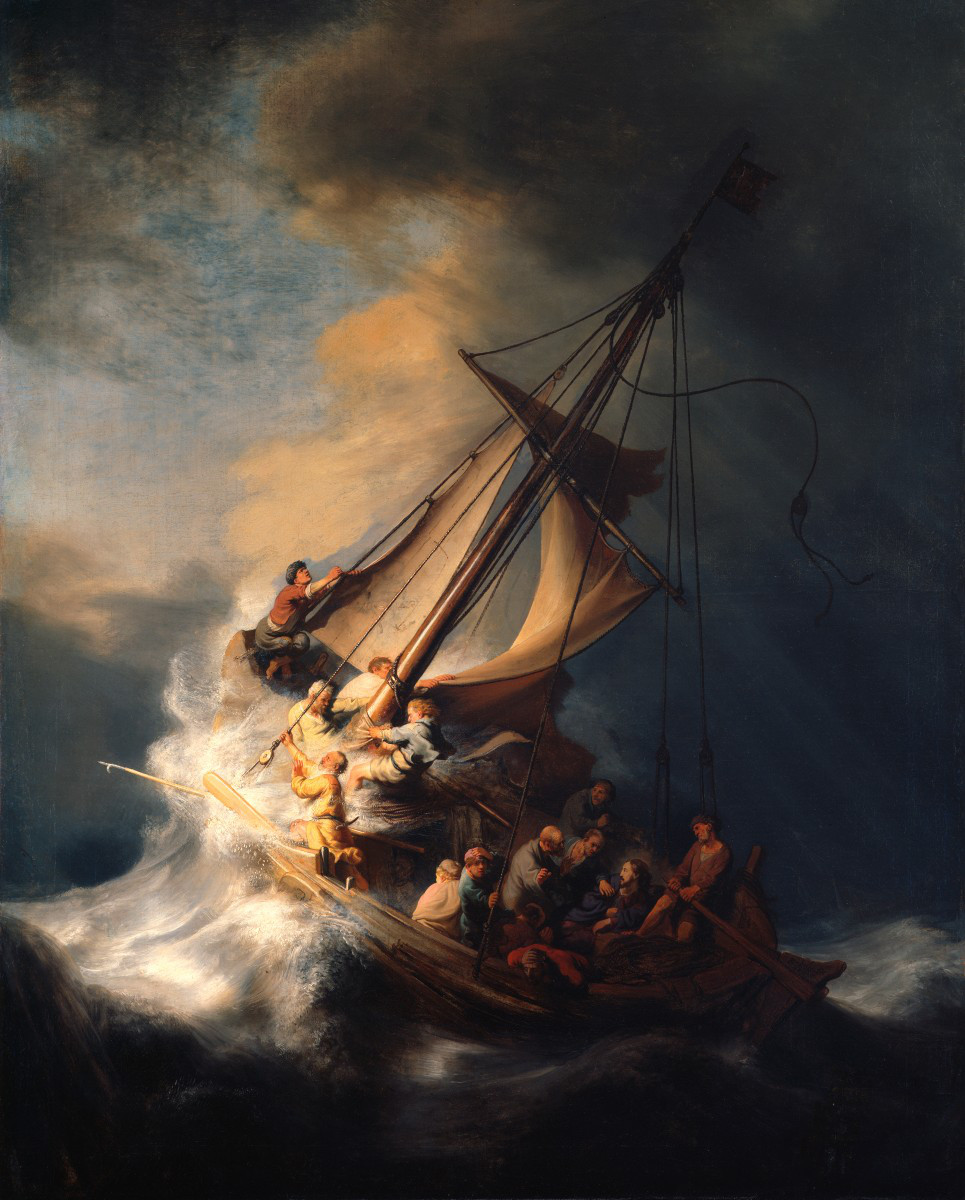
The Storm of the Sea of Galilee; Rembrandt Harmensz. Van Rijn

Chapter Four. The Trauma of  Holiness

“Hence the dread and amazement with which, a Scripture uniformly relates, holy men were struck and overwhelmed whenever they beheld the presence of God… Men are never duly touched and impressed with a conviction of their insignificance until they have contrasted themselves with the majesty of God”
John Calvin

God you are Holy. Let me never forget this, O Lord, please!

Sproul leads us through this chapter to different scenes, places, the first one is the Sea of Galilee. It was the night in which Jesus calmed the storm with His Word, yes, this is the event we all love to read about while trials and storms raise against us with fury. However, this time this event seems to be written to teach me more that the power of Jesus to calm storms. It is there to teach us about God’s holiness.

Jesus was waked up by his disciples who were in panic.

“Teacher, don’t you care if we drown?” (Mark 4: 38)

and in Sproul’s words,

“Their question was not really a question. It was an accusation. Their suggestion was thinly veiled. They were actually saying, “You don’t care if we drown” They were charging the Son of God with a lack of compassion. This outrageous attack on Jesus is consistent with mankind’s customary attitude toward God.”

Jesus did not say a word to them, instead He raised Hos voice and rebuked the wind and waves. Then He turned and asked His disciples “Why are you so afraid? Do you still have no faith?” (Mark 4:39-40)

And for some reason it seems that we have memorized only this part of the story. A powerful Jesus willing to calm the raging sea even when we have little faith. But the story hasn’t finished and Sproul encourages us to look at the reaction of the disciples, now that the sea was calm:

“They were terrified and asked each other ‘Who is this? Even the wind and waves obey Him!” (Mark 4: 41)

The storm was calmed and now, for the first time, Mark tells us that the disciples were terrified.

“The storm had made them afraid. Jesus’ action to still the tempest made them more afraid. In the power of Christ they met something more frightening than they had ever met in nature. They were in the presence of the Holy…
It is one thing to fall victim of the flood or to fall prey to cancer; it is another thing to fall into the hands of the Living God

We all have fall into some kind of desperation and fear in the midst of storms, rumors of cancer, tumors, broken finances, etc. and we seek desperately to the Master, we call Him, but truly, do we really want to see His Holiness in the storm? Maybe we will find out that the most terrible storm is not the one outside, but the one in our heart.

Now Sproul takes us to the same lake, however, the scene is another one (Luke 5:1-7). Luke tells us of the day when Jesus, the carpenter, told Simon, the fisherman, how and when to cast the nets to fish. And the question here that we must ask is this:

“How did Peter react? How would you have reacted? …
When the nets were bursting, Peter couldn’t even see the fish. All he could see was Jesus. Hear what he said ‘When Simon Peter saw this, he fell at Jesus’ knees and said, ‘Go away from me, Lord; I am asinful man!”

Again, we love this story because it tells us about a Jesus who provides miraculously, but why we always stop recalling the story when we feel we can’t benefit from it?

My country is plagued with the so called “Prosperity Gospel” and the “Modern Evangelical Christianism” of TV shows and praise and worship meetings, and what they have missed (among so many other things) is always the “next verses” those that bring us to our knees before the Holy One.
I feel rage when I see many looking after the gifts, the power, the provision, but run away before they meet the Holy One.

Our response to God’s power, to the manifestation of the Holy One, should be falling on our knees “undone”, crying “I am a sinful man”.

“We notice that Jesus did not lecture Peter about his sins. There was no rebuke, no word of judgment. All Jesus did was to show Peter how to catch fish. But when the Holy is manifest, no words are need to express it. Peter got the message that was impossible to miss. The transcendent standard of all righteousness an all purity blazed before his eyes. Like Isaiah before him, Peter was undone”

The chapter goes on, and Sproul warns us about the fake holiness of the Pharisees and Sadducees; I will not extend into that but you can read other comments on this chapter here, at Challies.

Today, as I consider all these, I can’t but be thankful for Jesus Christ. It is only through Him that I can come before a Holy God and not be consumed.

May we see Him as He is. May we find Him today as we consider His Word.

Related Posts:

The Holiness of God -Chapter One-
The Holiness of God -Chapter Two-
The Holiness of God -Chapter Three
The Holiness of God -Chapter Five-

>Giving Thanks to God and Others

>

Pixels and Stories (mom and daughter image)

Have you thought that sometimes it is easier to give thanks to God than to others?

This month, a month which some of us have set apart to give thanks, I want to be practical; I will give, first and foremost, thanks to God from whom all blessings flow, but I also want to show gratitude to those around me. How? Well,  I will be writing  “thank you” notes and “thinking of you” notes to many of my friends and relatives; some living in the same area, some others far away; and I will be doing this the beautiful and traditional way, with pen in hand and stationary paper… I have so much to thank each one of them!

Once, while in a journey, I walked in a bookstore that was on clearance and I bought this little book, for less than five dollars,  it has good and simple advices on how to write thank- you notes; so I thought you might enjoy reading some of her ideas:

1. Focus on the giver. Think of “the person who originated the act of kindness…”
2. Name the gift early. “Always connect the gift with the giver”
3. Don’t force or falsify a thank you. “rather, remember that by continuing to exercise your thank-you muscles you will begin to recognize the elements in every gift or kind act for which you can honestly be thankful”
4. Give a thanks on time. “Responding on time is important; but more important  is responding”
5. No- ocassion thank yous.  Give thanks to those who make your life richer and special.
6. Teach your children to give thanks and write thank you notes.  You can start as soon as your child starts to print.

The author includes some “Points of Etiquette” (page 40) few are here:

*Verbal thank yous for gifts don’t substitute for written ones.

*Stay away from general statements; make your thank yous specific.

*Don’t let your prose go beyond your true feelings.

I am planning on starting today! One every day, and mail them at the end of the week. My husband and children will receive one too. I have so much to thank them.

Pixels and Stories (mom and daughter image)

Well, today I raise my voice to say (#873) THANK YOU, LORD FOR SO MANY GODLY FRIENDS (including my best friend, my sister) that you have given me. That is a blessing indeed, even though many of them live in other countries or continents and I get to see them only once a year.

I am thankful, Lord, for all the technology that we have used to keep in touch with each other on a regular basis. I am so grateful for this! It is much easier to keep up building long-lasting friendships in this time than 15 years ago.(#874)


What are you grateful for today?

Join the Celebration here

The little book:

Find it here

>The Fruit of Her Hands -Part Four-

>

This is our last week reading together a very good book, The Fruit of Her Hands by Nancy Wilson. I have been blessed by all the comments of each one of you who have been participating in this forum. Thank you for your input; the conversation has been joyful indeed.

Chapter Seven. Lovemaking
What a wonderful chapter this is! I would dare to say that this has been my favorite one. Nancy Wilson takes The Song of Solomon as the best place to start because sex was God’s idea not man’s. In this book of the Bible (4:12; 5:1) the bride is referred to as “a garden enclosed”. It is not a public garden, but a private one; one with boundaries, one “within a protective fence that a marriage covenant provides”. 
As any other garden, the Christian woman needs to tend her own garden; How do we do this? “By being affectionate, approachable, warm, and responsive”

Let your fountain be blessed,
and rejoice in the wife of your youth,
As a loving deer, and a graceful doe,
let her breasts satisfy you at all times; 
and always be enraptured with her love.  (Proverbs 5:18- 19)

The author points that even though this verse is directed to husbands, there is a lot for us, wives, in it. She encourages us to rejoice in the marriage bed; she says that wives should not view sax as a mere duty or obligation, inconvenient and time-consuming, but a time of delight, of joy.
Nancy Wilson goes on to explain what it means to enrapture your husband with your love.

“This means that you must be more than simply responsive. You must be active in the sexual relationship. You certainly must delight him in a passive sense, but there is more required to enrapture him…this implies a great rejoicing on the part of both partners… This is not a teaspoonful once a week. It is a picture of a cup overflowing.”

There are hindrances that we must overcome at times, such as tiredness, fatigue, a big family, little ones, (and I would say teenagers who seem to be more talkative at nights!), not being in the mood, prudishness, and some others. How do we overcome all these? The author answers plainly,

“Put your theology into practice…
Don’t expect sudden, drastic, changes. our sanctification is a gradual process. But you should see progress as you apply His Word”

Again, studying the Word, abiding in it comes into play. We must bring, as I like to say, the doctrines into the kitchen…or in this case into the marriage bed!
This chapter ends with a word of encouragement for those Christian wives who have a non-believer husband, or are married to a man who doesn’t honor the marriage bed. I will just quote the author and encourage you, if this is your case, to read the book, or seek godly advice.
“Your godliness is never dependent on someone else. You stand before God in Christ and are accountable to Him for your behavior. 
Let God tend your garden, and do not let envy for other loved wives or resentment toward your husband ruin yours. and even if your husband does not see it or appreciate it the way he should, if he ever does wake up and open his eyes, he will see a lovely tended garden waiting for him”
Chapter Eight. Leftovers
This is a chapter in which the author deals quickly with some issues she did not want to left out. First of all she encourages the Christian woman not to pay attention to criticism and condemnation from the world against us. I like the way she says it,

“Criticism from the outside should be the result of our godly behavior, not our sinfulness”

Yes, we all know it. The world will certainly criticize us as we pursue our calling, as we seek to live holy lives, but we should always look at what the Scripture teaches and obey it.
Nancy Wilson also addresses the widows, and  all of us who will probably be widowed one day. (I never thought about that!) She encourages us to build a solid relationship with God and His Word, on her words,

“Wives, while your earthly husband is alive, cultivate biblical thinking about this. Good doctrine will be a tremendous help to you in trial. Believing and learning the right things about God are like storing up provisions for a famine. When affliction comes you will have a good store of grace available.”

She also addresses the topic of taking care of our elderly parents with love and honor and the real meaning of a wedding (going beyond flowers, colors and dresses).
Thank you, dear sisters for joining me in this precious endeavor, studying more about our role as wives and and moms. Thank you!

****************************
This is November of Thanksgiving; and today I want to raise my voice with other brothers and sisters to give thanks to God from whom all blessings flow.
871. Today I am grateful for God’s idea of marriage. 
Isn’t it a mystery indeed? One + One = One , how can that be? Lord, I am so thankful that you chose marriage to portray the relationship between Jesus and His bride. I am grateful for this covenant that bounds us together until death comes. I am grateful because in Heaven we will never be widowed, we will have YOU as our all in all, as our Husband and Maker. I am grateful for the marriage bed, for the warmth of two bodies; for hugs and kisses and love overflowing. 
872. I am also grateful for my husband, the lover of my soul. For his hands and heart. For the way he is. For the way he loves us and takes care of us. I am forever grateful for the marriage you have helped us build.

>November, Living with a Gratitude Attitude

>

Lord, give me a grateful heart in the season of joy, and in the season of tears.
When all is bright and when darkness comes.
When I want to raise my voice and when I don’t feel like giving thanks.

Help me, O Heavenly Father, to live in gratitude,
Help me to long only for you and nothing else.
Your gifts bring joy while I journey under your sun,
But they cannot be compared to the  One gift you have given,
Salvation by grace, forgiveness and hope,
To be with you, to abide in you, to embrace your Word.

O Lord, help me, help me,
I don’t want to set my eyes on the things that perish,
However, I am prone to be deceived by this world,
and the temporal delights it offers.

Help me, O Lord, to set my eyes on Jesus,
The Giver of every perfect gift.
The Author of my salvation.
My Lord and Saviour,
My King.

Today I am grateful for your many blessings. I thank you, O Lord, because it has pleased You to give us more than we deserve.

854. My parents’ health.

855. My Beloved’s diligence.

856. Friends on- line

857. My friend Fa who teaches me contentment.

858. My friend Amy’s prayers being answered. (Her husband is back at home after being deployed)

859. My Spanish students.

860.  My country.

861. Martin Luther and all the Reformers.

862. My eyes being opened to the understanding of the Doctrines of Grace.

863. My children’s love for each other.

864. A house to live in peace.

865. A table to share the bread and wine.

866. My daughter’s birthday party.

867. Our sons willing to dress up as soldiers for her little sister.

868. Strong arms to hold a piñata filled with candies.

869. The best sisters ever.

870.  An invitation to celebrate the whole month with a grateful heart.

Raise your voice with me today and let us give thanks to God from whom all blessings flow!

What are you grateful for today?

Consider joining a Celebration of Gratitude this November, read more about it here.

>Thoughts on Reformation Day

>

Stained Glass at the Wittenberg Church. We took this picture in 2006

Happy Reformation Day to all my brothers and sisters in Christ!


Today I want to share these notes taken from Practical Wisdom for Calvinists, I pray that you will be encouraged by them as I was.


1. Because all of us were Arminian in our thinking at once, let us “be patient with our brethren and recognize that both ethical and theological maturity takes time. In fact, there are some truths that, for whatever reason, we may not yet be ready to receive – as Jesus told His own disciples, “I have many more things to say to you, but you cannot bear them now” (John 16:12).”


2. Let us love all saints, even our Arminian brethren. Spurgeon said:


We give our hand to every man that loves the Lord Jesus Christ, be he what he may or who he may. The doctrine of election, like the great act of election itself, is intended to divide, not between Israel and Israel, but between Israel and the Egyptians – not between saint and saint, but between saints and the children of the world. A man may be evidently of God’s chosen family, and yet though elected, may not believe in the doctrine of election. I hold there are many savingly called, who do not believe in effectual calling, and that there are a great many who persevere to the end, who do not believe the doctrine of final perseverance. We do hope that the hearts of many are a great deal better than their heads. We do not set their fallacies down to any willful opposition to the truth as it is in Jesus, but simply to an error in their judgments, which we pray God to correct. We hope that if they think us mistaken too, they will reciprocate the same Christian courtesy; and when we meet around the cross, we hope that we shall ever feel that we are one in Christ Jesus (New Park Street Pulpit [London: Passmore & Alabaster, Vol.6] p.303).”


3. Most Arminians “are not rejecting genuine Calvinism, but distortions of it. One’s heart may be right, while one’s head may be wrong”.  

4. “Calvinism is not the Gospel.  One is not saved by a proper understanding of election, Divine sovereignty, or the extent of the atonement. These issues, no doubt, are important, but they are not the core of the Gospel; they indirectly relate to the Gospel (as do many other Biblical teachings), but are not the essence of it. The puritan, John Bradford, stated: “Let a man go to the grammar school of faith and repentance, before he goes to the university of election and predestination.” In the same way that it is wrong to detract from the Gospel message, so it is wrong to add to the Gospel message one’s particular theology. Once again, this is not to deny that the five-points of Calvinism are not important matters; but simply to point out that the minute one makes mandatory for salvation a correct understanding of election, effectual calling, or the extent of the atonement (regardless of how true they might be), they are guilty of adding to the Gospel. This is usually the error of young, zealous Calvinists (although not always), but to use the words of James, “My brethren, these things ought not to be this way” (James 3:10)”


Please, I encourage you to read the rest of this article here.


 Soli Deo Gloria!

>Time to Study Philippians -Week Four-

>

Greetings to the ladies of our Philippians study!

Welcome to Week Four~ This study and the following lessons, for the next four weeks, will be a condensed version of Mining God’s Word – How To Study the Bible; Foundation Series by Bethlehem College and Seminary Press. I highly recommend that you purchase your own workbook at www(dot)bethlehemcollegeandseminary(dot)org – it would be a great tool for you to have!

Let us look at Proverbs 31 to begin our study. 

“An excellent wife who can find? She is far more precious than Jewels…She opens her mouth with wisdom and the teaching of kindness is on her tongue. She looks well to the ways of her household and does not eat the bread of idleness. Her children rise up and call her blessed; her husband also, and he praises her.” (Pr. 31:1, 26-28)

May we be wives who are more precious than jewels, and with whom our husbands’ hearts can rest.

Homework from last week’s study:

Did everyone find five questions to write down concerning Philippians 1:12-26? I will list some of mine. You may have different ones, but you also may have the same. Did your questions encourage you to look further to find the answers?

Thinking about verse 1:12, did the Philippians think that Paul’s imprisonment would keep the gospel from spreading because of what happened to him? That they would be fearful? It sounds like Paul may be answering this concern by telling the Philippians that his imprisonment has actually been beneficial for the spread of the gospel. (1:12-14)

Are you curious as to whom “all the rest” are in verse 13?

Why would someone want to preach Christ (vs.15) if they do not love Christ? It looks like they want to get Paul into even more trouble than he already is! (vs.17)

Why was Paul concerned about not being ashamed, “…that it is my eager expectation and hope that I will not be at all ashamed, but that with full courage, now as always Christ would be honored in my body whether by life or by death.” (20-21)? Have others been ashamed? Have they brought shame unto the Lord Jesus by their actions?

Why is Paul revealing to the Philippians the tug-of-war that is raging in his heart about wanting to die and be with Christ and yet live for the sake of the Philippians (vs. 21-24)? I think it shows us how close the saints at Philippi and Paul were to each other, that he should share with them such a deep, personal, battle he was experiencing.

A summary for Philippians 1:12-26:

I believe Paul is encouraging the Philippians that his imprisonment has actually been a good thing – the gospel has spread, and it has made other brothers more confident, or bold, in speaking of Jesus Christ. Also, Paul lets the Philippians know that he is sure he will return to them.

We have already spoken a little bit about context. Context is what is happening around the verse, or verses, we are looking at, that will help us determine the meaning of our text. But, how many verses surrounding our text should we look to find the context? The verse before or after our text? Two verses before or after? The chapter before or after? The entire book? It can be a bit confusing and overwhelming, but it is something we should pay attention to.

There is a term ‘canonical interpretation’ which means that we view a specific text in relation to how it fits into the Bible as a whole. Scripture cannot and does not contradict itself. (We may not understand what is being said if we think parts do not fit together.) This means that the New Testament was written in light of the words, promises, and actions of the Old Testament. Remember, in Paul’s day, there was no New Testament. The Old Testament is what the Jews memorized and quoted from. Jesus and his disciples knew the OT and it guided their lives, thoughts and actions. So, as we read our New Testaments, and we notice that a part of Scripture is referencing an Old Testament passage, it is good for us to go back into the OT, check the reference and see what was occurring at the time it was written.

So, let’s look at two passages: Matthew 4:1-4 and Deuteronomy 8:1-10.  As you read these two passages, I want you to be looking for words that are repeated in both. On a piece of paper, write down the words written in both passages. (Be sure to know your contexts!) Do that and then come back to class and I’ll walk us through this.

Words that are the same (or very similar):Led, wilderness, tempted (tested), forty, hungry, Son, command, bread.(Our translations might have this list slightly different, but they should be close.)

Why do you think Jesus quoted this passage from Deuteronomy when Satan was tempting him? The Deuteronomy passage is talking about how God has cared for His chosen people, the Israelites. He is making a covenant with them; He is telling them what they need to do, (vs. 1, 2, 6) and reminding them what He will do – how He loves them and how He will bless them. However, did the Israelites obey their side of the covenant? Were they faithful to their God? No.

In Matthew, Jesus is using this OT scripture, to show that He is the faithful Israelite. Jesus does in the wilderness what the Israelites were supposed to do, but failed. And what is that? To humble himself and rely on God’s promises to care for Him – to keep the commands of God! And Jesus obeyed even greater than they. He does not use his own ability as the second person of the Triune God, to care for himself. Rather, He completely humbles himself to the will of God. His obedience, here and on the cross, redeems God’s people from sin, and is leading them into the Promised Land. (Amen!)

Seeing Matthew in light of the OT passage gives the scene between Satan and Jesus a broader, and clearer meaning.

Our homework for this week will follow along this idea. Most of our Bibles have notes that cross-reference Scripture with other Scripture. Sometimes it is only words that are repeated, and sometimes the cross-reference is to an idea, or theme. We will use Philippians 1:27 –2:11 for this week’s homework and practice using our cross-referencing.

Day 1) Read Phil. chapters 1 & 2, then go back and read Phil. 1:27 – 2:11. Re-read these verses a few times. Begin to look up the cross-references listed in your Bibles regarding these passages. Can you find any Old Testament references? Record on paper what you are finding.

2) Continue to look up the cross-references, and record what you find.

3) Continue to study your cross-references. There is at least one OT cross-reference. Be sure to get the context for the cross-reference by reading the entire chapter in the OT. What is happening in the OT?

Day 4) As you examine your OT cross-reference, write down what relevance you think it has to our NT passage. Does it answer any questions? Does it clarify any statements? Does it broaden our understanding of our verses in Philippians?

Day 5) Write down a summary of what you think this passage in Philippians is saying.
And we’re finished!

Thank you ladies, for studying and making God’s Word an important part of your day. May God honor your desire to know Him by blessing you with wisdom, grace and great joy!

Thank you, Becky, for once again giving me your time and your blog space to write this down.

Until next week,

Praise God from whom all blessings flow,

Eileen

***********************

 Are you just joining us; no worries, you are never late!  You can start this study at any time.