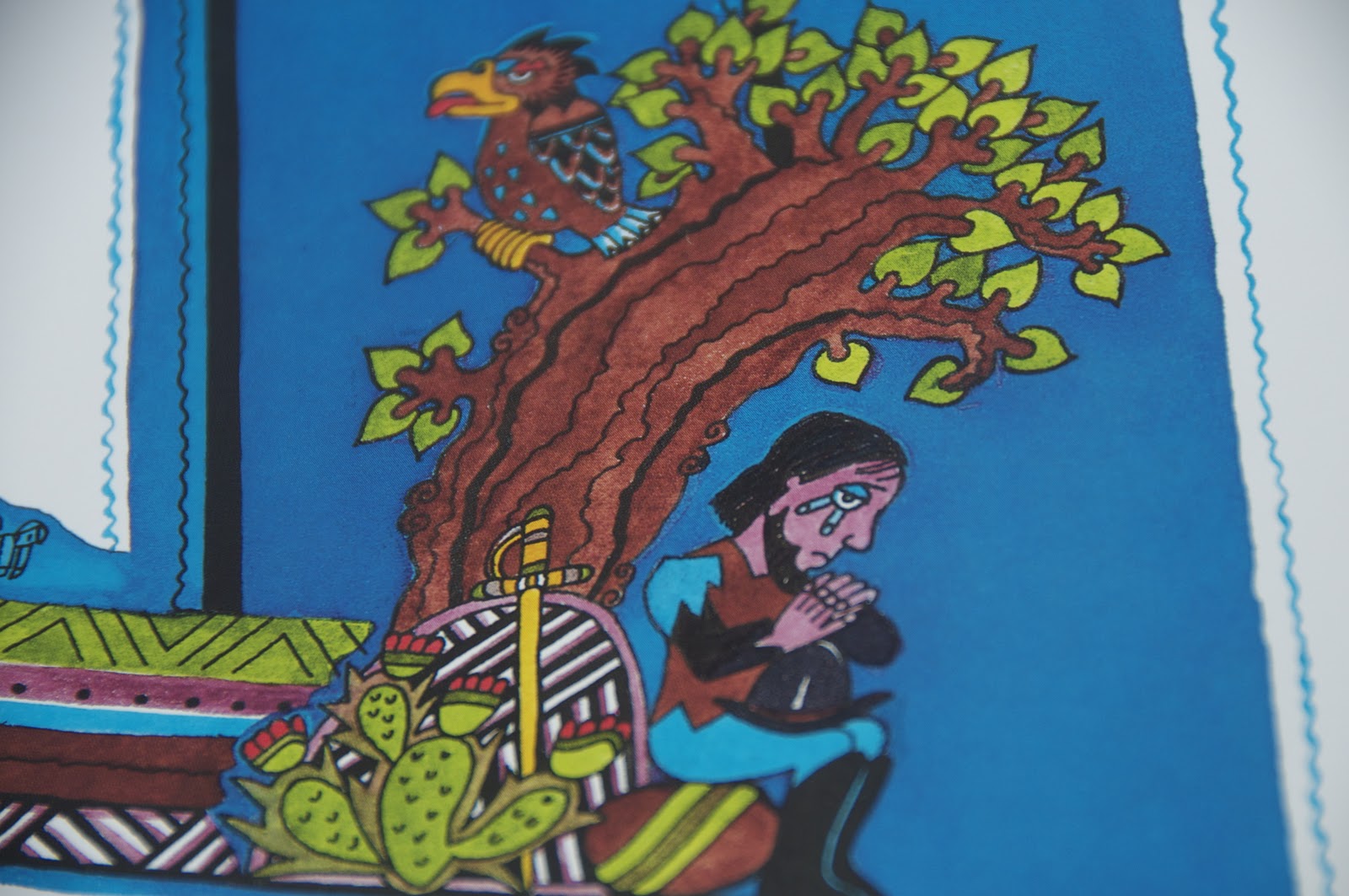
>Why Does the Mexican Flag has that Particular Eagle?

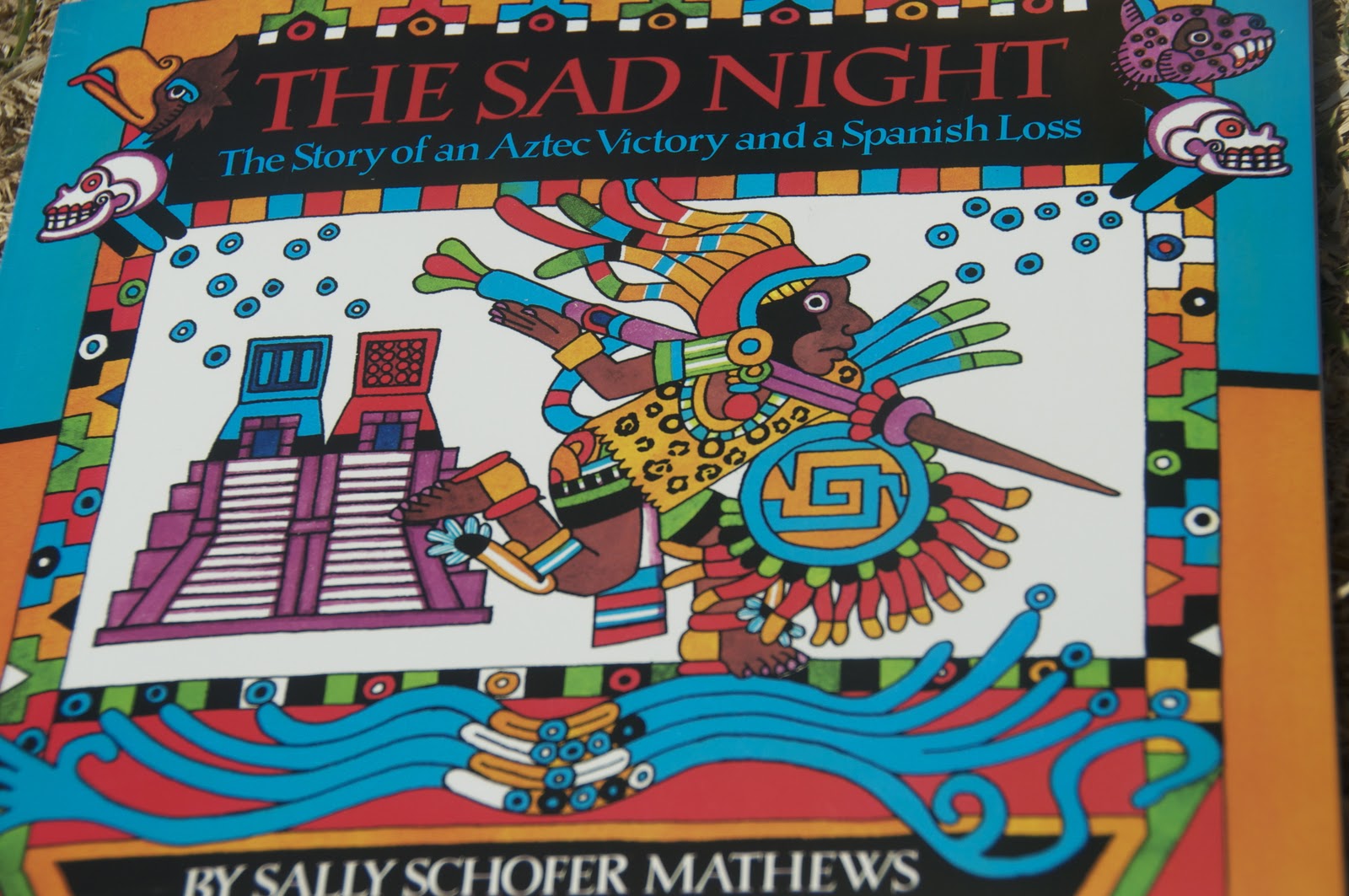
>Why does the Mexican Flag has that particular eagle, standing on a cactus, devouring a rattlesnake? You can read your little ones about this in this book I read to my little one this week. Yes, it is a very good, little book that my 7 yo enjoyed from the first page to the last. I really liked it because, even though it is short, it is accurate and the illustrations are beautiful.

The book is entitled The Sad Night, by Sally Shofer Matthew. 

And a little extra information for you ….

Why did the Spaniards finally conquered the Aztecs if they were outnumbered?

I have read many opinions and I have come to the conclusion that there were three important factors:

First the Aztecs had a totally different mindset when fighting. In Europe the idea was to win no matter what, in the Americas once a tribe fought and clearly won in battle that was it, it was settled who was the strongest one. However, the  Europeans were not going to be defeated like that, their interest were much more bigger than winning a one fight, than showing who was the strongest one. An Empire with many interests was behind all this. So, when the Spaniards lost this important battle (the Sad Night is the result of that loss) and they left. The Aztecs never thought that in a year they will come back with a larger army  decided to crash their civilization; that was not the way things worked on this side of the Atlantic.

The other factor was that these people, the Aztects,  lost because of all their superstitions. Moctezuma (yes, with a “c” and no with an “n” is the way we spell it in Mexico) was a great, brave warrior. He had the control over all the area (very BIG area, I have to say) No tribe was strong enough to resist the brutality of the Aztecs, however, through all this encounter with the white-bearded men  Moctezuma was paralyzed because all the time he was sure he was dealing with gods. At the end the generals and the people in general realized that gods or not they had to kill these men (gods?). Moctezuma tried to protect them ’till the end and this was his fall. People stoned him to death. (keep in mind the desperation that had to be happening here, the people “knew” that Moctezuma, their Tlatoani, was their god, so this was not an easy thing to do!)

Third, and most important, the Aztecs lost because it was written! Because God is sovereign over the nations, over the course of history, He is Lord over all, and He directs the history of mankind like the course of a river according to His infinite wisdom.

Well… I hope you enjoyed reading this, and I hope you get to buy this little book with a great story and full of  beautiful illustrations.

Have a blessed weekend, dear friends!

>Octavius Winslow’s Book -Help Heavenward-

>

The Octavius Winslow Reading Group

Matthew Blair, the blogger behind The Octavius Winslow Archive, invited his readers to read along a great book by Winslow; Help Heavenward. We are currently talking about chapter two, Progressive Meetness for Heaven, what an incredible book is this! I encourage you to join us, there is still plenty of time; the chapters are short and you can read them on the same blog. (Chapter One,  Chapter Two, Chapter Three “due” next Monday)

I really wanted to read this book, but for the sake of time I am not blogging about my reflections, however, you can still read my comments on this second chapter here.

Have a wonderful day, my friends!

>Carnal Christians?

>Today is Thursday, the day I like to share words I have read through the week.

These are borrowed words from R.C Sproul, on his book Romans; in which he talks about the doctrine of the “carnal Christan” which has spread so widely among Evangelicals.

We cannot receive Christ as Savior without at the same time bending our knees to his lordship. This does not mean we believe we are perfect, but it does mean that at the moment we believe, we are changed. Our lives are turned around, and the beginning of the process of sanctification has taken place. Justification does not produce the fullness of sanctification, but it initiates it immediately. If we have made a profession of faith but there is absolutely no evidence of change in our hearts and lives, then we need to ask whether that profession of faith was genuine. True faith always and immediately produces change.

Yes, indeed, the battle with sin goes on for our whole lifetime. We do not believe in instantaneous sanctification. Justification is instantaneous. The second we believe, we are fully justified. We will never be any more justified than we are at the moment we believe, but sanctification is a process that begins at our justification and is completed in our glorification in heaven. If we are believers, we are in that process of sanctification.”


I remember I grew under this kind of teaching; the only fruit that I saw, even in my own life, was that of living a double life. We all “understood”; we never expected holiness in the church because “being a carnal Christian” was a doctrine we all believed.

Sproul also says,

“We all sin, but if we have been born of the Spirit, we are no longer slaves to that sin. We can no longer say to God, “I cannot help it. I am dominated by the power of sin.” If we are still in a condition of slavery to sin, then we are not regenerated”

I encourage you not only to read the Scriptures as you would read any other book, instead, study them meditate, on them, memorize them; let them change you today!

Under His sun and by His grace,

>The Holiness of God – Chapter Eleven-

>

Yes, the turkey and some baking is awaiting for me; but I do not want to miss this last post on this last chapter of this wonderful book, The Holiness of God, by R.C Sproul, so while every one is still in bed, I will type.

The title of this chapter is, Holy Space and Holy Time; and it opens with a wonderful quote from C.S Lewis,

“Where, except in the present, can the Eternal be met?”

For me this is a very important chapter because it brings down to today, down to this moment, down to the place where I meet my God, His Holiness.

This is where we are as Christians, as believers, as seekers of His face; we are in a daily quest to be more like Him, to love Him more, to find Him more in every minute that frames our life.

“We seek a threshold that will lead us over the border from the profane to the sacred. It is a quest for sacred space, for ground that is holy ground”

We want that. We don’t want to be trapped in the moment, in the running, in the to-do list, we want to walk beyond to the transcendent because we know our God is transcendent; because we know that what we do here, today, right this moment has a transcendent consequence.

But I live here, I live in squares in a calendar, in hours made of 60 minutes, and here, in between this keyboard and baking muffins, and kissing the forehead of my children, in between teaching Spanish and the life of Leonardo DaVinci; and snapping pictures here and there; in between making beds and making love with my husband, I live in Holy Space and Holy Time, because God has come to meet me here, where I do my life.

Sproul reminds us that the “holy space Moses occupied was made holy by God’s presence” , and isn’t my home a holy space too? And it is holy not because we, this family which I love so much, is sinless, NO! it is because God has come to us. He has reached us. His presence abides in us; among us.

“Our contact with the holy is not merely an encounter with a different dimension of reality; it is meeting with Absolute Reality. Christianity is not about  involvement with religious experience as a tangent. It involves a meeting with a holy God, who forms the center, or core, of human existence. The Christian faith is theocentric. God is not at the edge of Christians’ lives but at the very center. God defines our entire life and worldview”

Am I a Christian? Do I live meeting with a holy God every day all day?

I am planning to make a nice turkey for our family and their favorite cookies will soon be in the oven; is God there? I slice an apple, and chop some chocolate; I pray to my God. I give thanks for His goodness. He is here, in the moment, in this place, my kitchen.

I wash the dishes again, and again and again… I can complain and be ungrateful, or I can pray I find in that moment, a sacred moment.

Dr. Sproul reminds us also of two holy times that frame our lives as Christians; the Sabbath and Lord’s Supper.

“Each Sabbath day, believers observe sacred time in the context of worship. It is the keeping holy of the Sabbath day that marks the regular sacred time for the Christian. The worship service is a marking of a special liturgical time. Because of the reality of the Incarnation, history itself becomes sacred for the Christian. We mark our calendars with reference to time that is B.C or A.D. We have a theology of history because we realize that there is a holy purpose to history, even our salvation”

And the our pretty wall calendar is coming to an end; and a new one is in the mail. We filled squares, we have filled until today, 357 more days under His sun. We have walked in history. We have been part of that Sacred History that He wrote. And we like to talk about new purposes for the next year… what about today? Why not right this moment?

Why not just live in Holy space and Holy time every day? Acknowledging His presence with in us, among us.

Sabbath comes not at the end of the week, but at the beginning of the week to remind us that the day we’ll stop breathing under His sun, rest will not be the last thing we do,  but the first thing of our new life not under His sun, but under His glory which shines brighter than the sun!

The second is the Lord’s Supper; Sproul reminds us that the celebration of the Lord’s Supper involves Sacred time in three distinct ways:

“First, it looks to the past, instructing believers to remember and to show forth Christ’s death by this observance. Second, it focuses on the present moment of celebration, in which Christ meets with His people to nurture them and strengthen them in their sanctification. Third, it looks to the future, to the certain hope of their reunion with Christ in Heaven, where thy will participate in the banquet feast of the Lamb and His bride”

I have a day ahead of me, I want to live it in sacred space and sacred time; I want Him to be my all in all every minute, every tic-tac; here this place, this home is sacred because He has come. I don’t want to miss Him.

“In sacred space and sacred time Christians find the presence of the Holy. The bars that seek to shut out the transcendent are shattered, and the present time becomes defined by the intrusion of the holy. When we erect barriers to these intrusions, dikes to keep them from flooding our souls, we exchange the holy for the profane and rob both God of His glory and ourselves of His grace”

May our lives be flooded with His Holy presence.

Thanks to Tim Challies, who has put together this reading group, and thanks to you who read along! I look forward to the next book!

Image from my photography blog, have you visited it?

This post is linked to Fields of Faith, because I have found that my field of faith is here, today!
>The Holiness of God – Chapter Ten- and Christmas-

>


“When I consider your heavens, 

the work of your fingers, 
the moon and the stars, 
which you have set in place, 
what is the man that you are mindful of him, 
the son of man that you care for him? 
You made him a little lower than the heavenly beings 
and crowned him with glory and honor” 
Psalm 8:3- 5 ESV

The chapter is entitled, Looking Beyond Shadows, and the Bible verse above is the starting point.  I have never thought what Dr. Sproul points out to us here, listen to him:

“These {Psalm 8: 3-5} were not the sentiments of a professional astronomer or a primitive astrologer. They were the reflections of an ordinary person who was contemplating his small place in a vast universe. The psalmist had no concept of an expanding universe that contained billions of stars and innumerable galaxies. He had no thoughts of exploding novae or of spiral nebulae. He had never heard of the Big-Bang cosmology. From his vantage point in space and time, the sky appeared to be a doomed canopy whose luminaries were perhaps only a few miles high in the sky”


I can not but put together this chapter with all the meditations I have been reading concerning the Incarnation of our Lord. 


This is what we should ponder about this season… “What is man that you are so mindful of Him?”

“With the meager resources the psalmist had when ge gazed into the night sky of Palestine, he was overwhelmed by the weighty sense of contrast between the magnificence of the heavens and the reality obscurity and insignificance of his own life. By considering the start, he was forced to ask the ultimate question: ‘What is man that you are mindful of Him?'”

This is where I see the connection… Why did You, O Lord, choose to come to rescue us… me?

Maybe I am starting to understand…

“Perhaps the psalmist was able to perceive something to which we have become almost completely blind. Perhaps it was because the psalmist could see past the stars and the moon to the ONe who set them in the heavens in the first place”

Yes, O Lord, help me see beyond the shadows; through the stars and the ordinary; Help me see you!

These words I read and re-read, these words say s much about me.

“We are creatures who prefer life in the cave to the full light of the blazing sun. The glory of God is all around us. We cannot miss it. However, we not only fail to stop and smell the flowers, but we also fail to notice the glory of the flowers’ Maker.


Indeed the featured presentation in te theater of divine majesty in which we walk daily is God’s glory. The Psalmist declares that the sky and all of nature sing out God’s glory and majesty”

This is the Holy One who was indeed mindful of his creatures and came to them. The creature became creature. The Holy One came in flesh.

But we cannot see beyond shadows if we haven’t been  regenerated by the Holy Spirit. We are not able to see beyond the beauty of the world around us, we are not be able to see  beyond the stars or Christmas lights; we are not able to hear beyond Christmas carols or the beautiful sound of ocean waves crashing against huge rocks; we are not able to see His holiness, His Glory beyond shadows if we have not been born of the spirit. If our eyes have not be opened to see and our ears have not been opened to hear. We desperately need Him.

“Shadows in a cave are given to change. They dance and flicker with ever-changing shape and brightness. To contemplate the truly holy and to go beyond the surface of creaturely things, we need to get out of our self- made cave and walk in the glorious light of God’s holiness”

Walking out from shadows…

Thanks to Tim Challies for choosing this book.