Because We Never Stop Being Moms- Book Club- Chapter Two

This week’s chapter is one that kind of brings us back to the early years. Back to when we were just starting to read books about parenting; in chapter two, Newheiser gives us some means God may use to help us achieve two main goals that we must have in mind as we raise our children; principles which are the core foundation that our children will, God willing,  take with them before they walk out of our home’s door.

But before I continue, I would like to take a minute to encourage those moms who are reading along, and know that they have failed to instill these truths in their children’s heart. Maybe you came to an understanding of what true parenting means too late in life, or maybe you were just too busy doing other things that you left aside the essence of a true education in the Lord. It is today the time to repent, to find forgiveness before God, and move on. Move on, to seek restoration with your children and to pray fervently for them. God is full of grace and Grace meets us when and where we need it most. It is never too late, as the authors of this book say, to “Show them Jesus.”

And now a word for moms with younger children, read this and make it your priority to install, by the grace of God, these truths in your child’s heart.

Book Talk

Chapter Two: Before You Walk Out That Door…

Newheiser, starts this chapter clearly stating that respect must always be present in our relationship with our children. It is one of the key factors he says, that enables us to shape their hearts as they mature. When I respect my children’s point of view, when I learn how to listen patiently (as we read in Ch.1), I can build a relationship in which my advice can be taken. How important it is to take note of these words to avoid falling in the trap of thinking that we know best and we never fail to have the perfect advice:

“They [their children] trusted our counsel because we respected them and only spoke absolutes when we could prove our point clearly from the Bible.” (emphasis mine)

Now, the author points out two main goals we must have as we raise our children into maturity (same goals that Paul had for those he was discipling): 1) that they will love from a pure heart and a good conscience and a sincere faith (1Tim.1:5 NASB), 2) and they will come to know and to believe the love that God has for us (1 John 4:16). To reach these goals, Newheiser suggests these means:

1. Teach your children the love of God in Jesus Christ. This is, Newheiser asserts,  our primary calling: to show our children Jesus.  And how is it that we are going to show them Jesus now that they are adults? The only way to do this is to live in such a way that we may invite them to see our manner of life and imitate us.

2. Teach your children to fear God and live for His glory.  True, “we cannot make our children wise.” But we can continually pray for them; “pray that the Holy Spirit will use our meager, faltering attempts as means to speak to our children’s hearts.”

3. Show your children how to put others ahead of themselves. How much we need this in the body of Christ!  Men and women who are willing to live putting others first -in all possible practical way- is, without a doubt, a need in the church and in our communities. And there is no other way to teach them how to live like this without first pointing them to Jesus and setting an example ourselves.

4. Help your children how to communicate with wisdom and humility. This is teaching them “the art of avoiding unnecessary offenses though quarreling, and careless or angry speech.” It means also, teaching them how to listen actively and carefully to build each other up, to solve conflicts biblically, and to confront sin with all gentleness.

5. Teach your children God’s design for sex and marriage. This is not trivial, in this age there are many false teachers -especially among our young adults- spreading the lies of egalitarianism.What a gift to teach them from the Bible the different roles God gave men and women.

6. Teach your children to choose their friends carefully. This point reminded me of something Douglas Wilson posted this week: As you choose your friends, remember this — you are choosing what you will be praised for. Amen to that.

7. Let your children practice making the choices of adulthood. By doing this we encourage them into maturity and dependence on God. We want them to take firm steps, not to be crippled.

8. Teach your children the true value of hard work and money. To work hard to earn a living, but not to live to make money is, in my opinion, a perfect way to explain this.

The author finishes this chapter by encouraging us to keep praying and seeking God’s wisdom to be able to discern and to have our hearts enlightened “to correctly say either ‘good-bye’ or ‘please stay.'”

As I finished reading this chapter, I kept thinking that the only way to truly be at peace about our children leaving our home is to trust their are the Lord’s and that He will finish His work in their lives. Trials will come, difficult circumstances will arise, but to know that they have been raised in a covenant home must help strengthen our confidence. When we have raised our children in the fear and admonition of the Lord; when we trust wholeheartedly that our Lord wants to save them and sanctify them, then we can continue to pray and persevere in building a relationship with them in hope. It is Grace, the Grace of God, that draws our children to Him, it is His loving-kindness that leads them to repentance, and His Mercy that welcomes them. Now they are adults, maybe they are not living at home anymore, but we can approach them as brothers and sisters in Christ understanding that we belong one to another because of Jesus Christ, our Lord and Savior.

Now, Friends, I would love to hear your thoughts on this chapter, join the conversation by leaving a comment below.

Have a blessed day, sisters!

Becky
Because We Never Stop Being Moms -Book Club- Introduction and Chapter One

Thanks for coming!  I am very excited to start this online book club with you; and even though nothing substitutes a face to face discussion, I am confident that this will be a blessing to all of us. Isn’t technology a blessing?

Book Talk

Introduction

Jim Newheiser in the introduction of the book tells us that one of the reasons why he decided to write this book was because he couldn’t find books to help him and his wife learn how to deal with the challenges they were encountering in the new season in their lives: “challenges that confronted both [them] as parents and [their] sons as adult children”.

Newheiser asks, on page twelve, some questions that well-intentioned parents have asked when the time to let go of their adult children arrives; and this one, in my opinion, is the hardest one to answer, “What should parents do if their children make choices with which they disagree?” As we’ll continue to read on, we’ll find many of our questions answered.

I appreciate on page thirteen that the author makes it clear that this book is “based on the assumption that Scripture is sufficient, not only to tell us how to gain salvation, but also to help us establish wise, godly relationships with our own adult kids.” Yes, the Scriptures are the key and the door; the map and the road that will help us be better parents, better spouses. Sometimes, however,  we need the advice from a friend, a counselor, or a book to help us see with more clarity and to understand better the things that are not evident to us right in the midst of the circumstances we are going through. So let’s continue considering this book with a grateful heart for books like this one, and friends like *you,* who recognize that it is only when we rely on God that we can bless our children no matter what age they are.

Chapter One: Is It That Time Already?

So true! All our stories are complex because we are complex people. The relationships among us “are often a tangled web, woven over decades. For this reason, none of [our] stories is black-and- white, and each requires wisdom from the Lord.”  This made me think that we will need, as we read on, to be able to distinguish principles from methods.* The principles apply to every case, the methods may vary. As we read on, let’s pray that God will help us understand which are the principles and discern which methods are the best for us to approach in our relationship with each one of our children.

The fact that the brevity of the season of parenting our children is God’s design, is a comfort to every  momma who thinks she will never be ready to let them go. If it is God’s design that children must leave their parents, and it is, it is then a very good thing: good for them and good for us.

God’s design is perfect and perfect are all His ways. If we believe this, it will be easier for us to start preparing our hearts for the day our children leave. God’s design is perfect and it will do us good to trust Him on this.  I love the author’s input on this matter, because really, we all have heard so much about the “empty nest,” that without even giving much thought to it, we are dreadfully expecting its coming (like we were once having nightmares about the “terrible-two-years” or “the-impossible-teen-age-years”), and making room for it in our hearts. Yes, we don’t necessarily like change, “particularly when the change means that our identity and relationships must be reshaped,” but doesn’t this make you think on how important it is for us, in the first place -and pass this to younger moms-, to strive daily to have our identity well grounded in Christ? Who we are in Christ should be the anchor of our lives in any kind of waters.  

“We’ve come to realize that the term  empty nest is misleading. When the kids leave, the nest is not empty because you are both still there. Furthermore, as your marriage relationship grows and becomes even stronger, your home can become a very special, warm place to which your adult children will want to return for special family events and holidays. And it can be a place where they can seek refuge in times of trouble. Empty nest? Hardly.”

Besides the challenge of the idea of the “empty-nest”, do you agree with me, that maybe one of the hardest things to do in this new season of our lives is to understand the changing of our attitude toward our children? To remember that “we are not to fight to maintain control, but to strive to change our relationship from in-control parents to respected friends” is not easy. It takes practice and intentionality as well as time and many conversations.

Openness, mutual respect, and love (p.21-22) are key elements, the author says, that should be present in our relationship with each one of our children.  One of the most important ways to show that we are pursuing these three is by being good listeners. I totally agree with that one answer a parent gave to the author,  “The greatest challenge has been not giving my opinion about things. I often have the urge to offer advice in order to help my children keep from making mistakes or poor choices.” What about you? Is this a hard thing for you too?

Do you remember how we used to repeat over and over -and over- again the same instruction to our little ones? I am sure we all, at a certain point, said the ugly phrase in an ugly tone, “How many times do I have to repeat to you not to do that!” Well, maybe now it is the time to repeat over and over -and over again,  to ourselves how much we need to listen with love, patience, and attentively to each one of our children. Moms, let’s be intentional: “No Interruptions Allowed Here” might be a good sign in the kitchen.

“If we can patiently learn to listen rather than always demanding to be heard, as James 1:19 teaches, our child will know that we respect his opinion and his right to differ with our views.”

Where to look now that our children are becoming independent?  Now as always, we must look to Jesus. Jesus was, and the author reminds us through different examples, the perfect son to Mary and Joseph. Jesus was an independent adult who never failed to honor his parents. But wait, let’s linger a little bit more in the story plot. What about Mary? She never tried to pull him back, to restrain him, or to manipulate him. Oh, she was indeed full of grace! That God may fill our lives with such grace and wisdom!

“It is a sad reality that some parents sinfully abuse their position of authority.”

This abuse not only happens when mom and dad are bigger than their child and misuse the rod. We don’t have a rod anymore, but we have words, and they sting and hurt even more. All the cases we read about on page twenty-six are not that extreme, they do happen. Can we think of a case in which I have tried to use my authority to push my adult child into a certain decision? Am I falsely accusing him for not being submissive and for not honoring me when his only fault is that he has a different opinion than mine?

“[O]ur young adults are responsible before God to make their own choices. They are responsible to choose their vocation, marriage, partner, and place of residence.”

Because we all are sinners, “every human relationship requires grace to survive.” How true this is! And how true that “we are tempted to think that our own way is the only way. We’re really convinced that we really do know best.” We should know best, of course! But when we are in the midst of a conflict, hearing the clashing of opinions, it is pretty hard to take a deep breath and say, “I will think more about what you are saying. I will give it a thought, pray about it, and we can talk more about it later.”(Note: Don’t just say these words to appease the moment, actually go and give a thought to what she thinks, pray about it, and pursue a follow-up conversation)

And there is no better way to end this chapter, and to enter this new stage in which there are so many practical applications, than with “the power of forgiveness and grace we have been given in the gospel.”

Being Intentional:

The three questions at the end of the chapter are meant to make us think, to draw us to the Word, to prayer… and most likely to converse with our own husbands and, in some cases, we will be drawn towards our own children to ask them forgiveness.

A note on question number three: This question talks about our marriages and asks us what kind of concrete actions we should take to make our marriages “sing again.” Please, Friends, let’s resist the temptation to think that we have nothing to do to make our marriage better (that all the problems in our marriage are our “husband’s fault”. We need to be intentional about putting in practice all that we are learning, all that we are called to do.)

Now it’s your turn. What challenges did you find in these pages? Any particular quote that struck you hard, or one that gave you hope? Or, perhaps you have been walking through this road longer than the rest of us, if so, do you have a piece of advice, a word of encouragement for us? Share your thoughts here, in the comments.

Again, thanks for joining me in this book club.

Next Wednesday: Chapter Two: Before You Walk Out That Door…

Becky

*I learned about the importance of differentiating principles from methods from Pastor Douglas and Nancy Wilson’s talks and books (you can read a good article about this here).

***Feel free to grab and share the image with the bible verse/ quote.

Because I Want you to Read Along -A Book Giveaway-

I don’t know if it’s only me, but I can hardly find blogs, books, or good articles to encourage women who, like me, are entering this new stage in life in which “all of a sudden” you are a mom of young adult children. Soemtimes Nancy Wilson at Femina, and Carolyn Mahaney at Girltalk have some pretty good -and challenging- stuff for us, but for the most part, what is written out there is directed towards young moms.

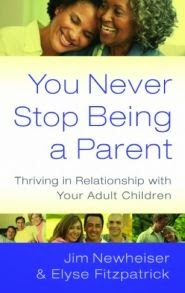
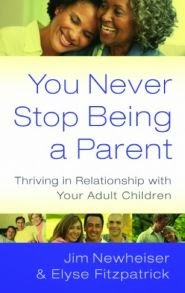
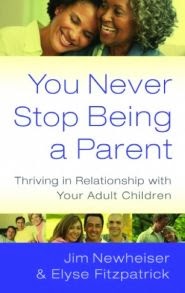
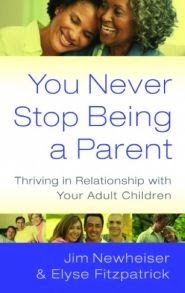
Yesterday I shared about a book I will start reading and, God willing, blogging about starting on February 5. This book, You Never Stop Being a Parent: Thriving in Relationship with Your Adult Children,  will certainly be a blessing to many women who are asking themselves many questions like how their role as a mom changes once their children become adults. So, today, and because I really want you to join me reading in along, and because I know some of my friends are purposely not buying any more books on 2014 (only after they finish the pile they already have at home!), I have decided to give away one copy of this book.


An invitation to read along

So if you want your name to be in the drawing, just leave a comment here. I will announce a winner next  Wednesday, January 22 (USA only).

And if you are not in this season of life yet, make sure to pass the voice among your friends, and don’t forget to enter your name in there; if you win, you can give the book to your friend, you know she will be very happy, right?

Under His sun and by His grace,

Becky

So, I am the Mom of Adult Children; What do I do Now? -And an Invitation to Read a Book among Friends-

There comes a day when three of your children are in college, and right after that comes the day in which the oldest of them bows on his knee to propose marriage to a beautiful young lady. That day you know you are, without a doubt, in a different stage of life. So you smile, swallow hard, and give thanks.

Yes, that’s it. The tiny hands pulling from your skirt, the toys all over, the three-lines songs about chickens and cows are way past gone. No more diapers, no more hours trying to choose the best homeschool curriculum, no more multiplication tables or Latin chants. You are, finally, living in the days which, for the first months in the life of your oldest child, you were sure were never going to come. Yes, oh yes, children do grow up. Pretty fast. In front of our eyes. Eating our food -soul food and body food- And it doesn’t matter if at times we feel like we don’t even know when or how in the world that thing happened.

We believe we are, finally, in the stage in which the sleepless nights are gone…

Oh, wait.

Seriously?

No, not really. We now pray all night while they sleep.

Now, as I see my son and his fiancé planning their wedding; as I listen to my daughter’s deepest heart’s beats as she starts a courtship relationship; as I listen attentively to my youngest son’s dreams; and as I pay attention and watch the way he is building those dreams with his own hands, I find myself asking,  What do I do now? What am I suppose to do now, Lord?

Three words keep coming to my heart (my words for 2014) as I try to answer these questions:

Grow where you are. In this new stage of life, learn and grow.

Build bridges among them and towards them.

Edify their lives with words and deeds.

I know well that in order to grow I first need to learn. Learn new rhythms, new patterns; I must learn how to play on the stage of life the new roles God has assigned me. And just as I read dozens of books on parenting, and childrearing, and potty training, and the reproduction of brain cells in the early stages of life -listening to Mozart, of course-, I now need to sit down again and read to learn.

I want to learn how to be a faithful mom of adult children, a wise mother-in-law, and a good wife to my husband in this new and unknown season of our life together.

Perhaps you too are entering into this new season or maybe you are already changing the diapers of your grandchildren! It doesn’t really matter, I am thinking that we should read this one book along, and then come and sit together here, once a week, to discuss it and encourage one other to learn and grow so that we can effectively build relationships with our sons and daughters, as well as keep edifying their lives.

Will you join me?

Buy through Grace and Truth Books

The book: You Never Stop Being a Parent: Thriving in Relationship with Your Adult Children by Elise Fitzpatrick and Jim Newheiser

The plan: A chapter a week starting on February 5 (there are 10 chapters, a conclusion and four appendixes). I would love, ideally, to finish it on April 2.

You have enough time to order your book and get it before February 5. I really hope you can join me, I am sure it will be a blessing.

Grow, Build, and Edify in Him and through Him,

Becky