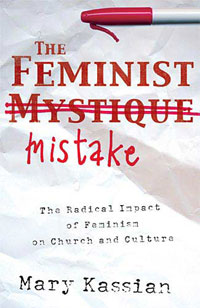
The Feminist Mistake by Mary Kassian -My Review-

A professing Evangelical woman today will try to say that she is not a Feminist, that she only believes that in marriage (and Church) there should be no hierarchies, that in Christ we all are one and that we, wives, are not longer called to submit to our own husbands, instead we are both (husband and wife) called to submit to one another.  Is this even possible?

Mary Kassian’s book: The Feminist Mistake, The Radical Impact of Feminism on Church and Culture is an extremely important book in all this “gender debate” issue. And it is important because of at least three reasons:

1. It helps us understand the origins, the philosophical and theological views of Feminism and how it found its way into the Church.

2. It also help us understand how it is impossible to be a Feminist and a Christian. You can’t embrace both. Feminism always leads to a “new kind” of theology which has its own hermeneutic methods to interpret the Scriptures, so that it would be able to “support” its own beliefs.

3. It helps us understand that the so called “gender-debate” (egalitarianism vs complementarism), goes beyond the issues like “who takes the final decisions at home.” Feminism leads, little by little, to a complete non-Biblical view of God, and the world.

Kassian’s book is well written, clear, and engaging. It is also well researched and it includes a great number of references. Mary Kassian’s approach is objective, and does not deal with the subject as if she were in a “witch hunt,” she presents a professional historical account, and always from a solid Biblical standpoint.

The book is divided in two parts: The Philosophical Quake and Shock Waves

The first part is subdivided in three stages:

1. Naming Self (here she explains how women decided to name themselves, instead of letting God name them, define who they are).

2. Naming the World  (two of the things she deals about in this stage are: Women-centered Analysis of Theology and Women’s Studies in colleges).

3. Naming God (the feminization of God, and women and their place in the Church are discussed here).

In the second part of her book, Kassian deals with the advent of “biblical feminism,” the hermeneutic methods they use to sustain their “egalitarian” position, the  “what-to-do-know” kind of questions, and what will happen next if we refuse to see the danger feminism represents and we neglect to stand firm against it.

I would like to share with you some quotes on the matter of Feminism and Theology:

“In order to harmonize feminism and religion, Daly found it necessary to reject the theology that presented God as omnipotent, immutable, and providential, for she believed that this view discouraged women from seeking change. Furthermore, she viewed images of a jealous and vengeful God as projections and justifications for the role of the “tyrant father in patriarchal society” rather than as actual aspects of God’s character. The concept of an almighty, all-powerful, unchangeable, caring, providential God, jealous and demanding worship, was, according to Daly, an inadequacy in the conceptualization of basic doctrines which sustained and perpetuated androcentric theological teachings.” (p.47)


“Feminist theolgians, therefore, took the liberty of discarding passages of the Bible that did not agree with their vision of sexual equality. They either dismissed the text as outdated -relative only to a particular time and culture- and the author of the text as misogynistic, or they interpreted it and assigned it a meaning different from what the author had intended. The dynamic view of the Bible that feminists adopted allowed them to adjust biblical interpretations in order to make the Bible relevant to the problems and  perspectives of women in contemporary culture. Feminists argued that biblical interpretation could and should change.” (p. 108)


“Traditional symbols of the church had presented God as “He” and as King, Lord, and Judge. Feminists maintained that these religious symbols excluded women. The symbols needed to be updated to accommodate the new feminist consciousness. According to feminists, linguistics symbols of the Bible and church, as well as of God, needed to be altered in order to bring them into line with the inclusive equality of women.” (p.162)

Ruether and Stendal, two influential feminist theologians, said that “those who imaged God as male were guilty of idolatry,” and that “those who believed that God was, in some way or another, male were guilty of idolatry.” The author rightly responds,

“…by changing the biblical symbols, Russell altered and renamed God. This is a serious matter. For if feminism’s altered view of God is out of synchronization with who God really is, as He has revealed Himself, then it is not really God whom they are imagining and worshiping; and this is the idoaltry that the Bible condemns.” (p.168)

When women start re-naming God and try to de-sexualize Him, what they end up doing, according to the author’s analysis, is they depersonalized God, they attack God’s character,  they deny the Trinitarian relationship, they obscure the person and work of Christ, they obscure humanity’s relationship to God, and their own personal identity (p.168-173).

If you read this book carefully, you will clearly see the philosophical progression of feminism.

Mary Kassian says,

“While I do not deny that feminist vary in political theory and theology, I maintain that are all part of a larger continuum that supersedes and encompasses those variations. A feminist, at any given point in time, may not see herself or himself at the radical end of the movement, and I am certain that some individuals will never change their personal views to that extent. But the dissociation of one’s brand of feminism from the remainder of the feminist movement is a naive denial of reality. The philosophical progression of feminism is both coherent and logically immanent.” (p.241)

Maybe you are one of those who “sees feminism as an ideology that merely promotes the genuine dignity and worth of women.” Read what Mary Kassian wisely says on the matter:

“If this were true (the statement above), feminism would definitely be compatible with Christianity, for the Bible does teach that women and men are of equal value in God’s sight, co-created as bearers of God’s image. But the philosophy of feminism adds a subtle, almost indiscernible twist to the basic biblical truth of woman’s worth. Feminism asserts that woman’s worth is of such a nature that it gives her the right to discern, judge, and govern that truth herself… Feminism does not present itself as at outright affront to the Bible, but it nevertheless contains an insidious distortion that erodes the authority of the Scripture. Acceptance of the feminist thesis may not drastically alter one’s initial beliefs, but if followed, it will naturally and logically lead to an end miles away from the Christianity of the Bible.” (p. 261)

What now? Why should you read this book if you are not a “biblical feminist” (or an egalitarian)? I assure you, sisters, that the rise of this movement is coming more rapidly and with more fury than we can even start to imagine. We need to be ready to discern it and be well grounded in the Word of God to be able to teach our daughters (and sons) the dangers of this lie.

Let us press hard and embrace our precious and wonderful calling which is good, because God said so. Let us not be afraid, sisters, to be named by God, to embrace the beauty of our place in His story.

Then the man said, ‘This at last is bone of my bones and flesh of my flesh; she shall be called Woman, because she was taken out of Man’” Genesis 2:23

Under His sun and by His grace,

Becky

Mary Kassian blogs at Girls Gone Wise, and True Woman


*********************

 

Love Hopes All Things

100 Days of Books at My Daily Journey

Every morning after having breakfast we are reading a very important book, Loving the Way Jesus Loves by Phil Ryken. And this is an important book, because as I have mentioned before, the doctrine of the love of God (His love for us, and the love among brethren) has been abused in so many cases that sometimes it feels like it is not essential to understand and study it in the Christian life, we just take it for granted or “use” it against “the unloving brothers and sisters” when we feel offended.

In the chapter, Love Hopes, I learned many wonderful things about the love that hopes. In this chapter Ryken bring together two passages to help us understand in depth the “love that hopes”: Love hopes all things ( I Cor. 13:7), and John 17, the High Priestly Prayer.

When Jesus is praying before the Father the night before his crucifixion, he prays a prayer full of love, full of that love that hopes all things. And he prays hoping for several things:

He hoped that he would be glorified (v.1-5).

He hoped that his people would persevere (v.10-15).

He hoped that his people would be holy (v.16- 19).

He hoped that we would be one. He prayed for our unity (v.20.23).

He hoped that one day we would enter his glory (v.24-26).

Each one of these points are extremely important and beautiful when we look at them closely (and Ryken does a great job in helping us do that), but today I want to focus in one: Jesus prayed with all hope that we, His people, would become one.

Ryken says,

“We are too weak to to keep ourselves safe from Satan’s temptations, too sinful to sanctify ourselves, and too dead to raise ourselves up to everlasting life. Nevertheless, Jesus dared to hope that we would become one holy and loving church, kept safe by the end of time, when we would live in the love of God for all eternity.”

Because Jesus prayed this, I also dare to pray saying, “Lord, make us one, make us one. Make us one, help us love one another in spite of the differences, help us love one another genuinely. Make us one, Jesus. “

And this wonderful love that hopes all things has been poured into our hearts (Rom. 5:5), which means that we can love with the kind of love that Jesus loves us. We can love with the love that hopes all things. And “this hope will not disappoint us because it flows from the God of love.”

“Hope is not simply wishful thinking. It does not depend on things working out the way we planned, or having our problems solved when we expect them to be solved. On the contrary, our true hope is Jesus himself, and the promises of his love.”

This love that hopes all things brings us to our knees, just like it brought Jesus to his knees. “When we have the love of Jesus in us, as Jesus prayed we would, then we will do for others what he did for us. We will not simply hope for the best, but because we have of the hope we have in Jesus, we will pray for the best.” 

“Love hopes all things. Understand that whenever we give up hope, this is really a failure to love, because love hopes. Love hopes that someone lost in sin will believe the gospel. It hopes that a broken relationship will be reconciled. It hopes that by the grace of God, sin will be forgiven, and forgiven again. It hopes that even after a long struggle, there will still be spiritual progress. It hopes that someone who has fallen away can be restored to useful service in the Kingdom of God. It even hopes that when a body gets sick and dies, it will be raised again at the last day.”


Praying that I will learn to love with the love that hopes all things, 

Becky

Maybe you will also enjoy reading: The Doctrine of Love: Our Identity as Christians.


*******************

Come Ye Children, a Book by C.H. Spurgeon (Mandatory Reading for Parents and Teachers)

37/100 Days of Books
There are some books that I love to revisit once in a while. It is great to read my notes, and the parts I highlighted. Yesterday I pulled out from the shelves a little book that to my surprise I read in 2009 (I couldn’t believe it had been such a long time since then!), the book was written by C.H. Spurgeon and is entitled, Come Ye Children: Practical Help for Telling Children About Jesus. This is a book full of practical help based on biblical principles to encourage us (parents, teachers, and pastors)  to do well and with passion, the task we have before us of training our children in the Truth.

Here are some quotes that I am sure you will appreciate:


“As we sow we reap. Let us expect our children to know the Lord. Let us from the beginning mingle the name of Jesus with their ABC. Let them read their first lessons from the Bible. It is a remarkable thing that there is no book from which children learn to read so quickly as from the New Testament: there is a charm about that book which draws forth the infant mind. But let us never be guilty, as parents, of forgetting the religious training of our children; for if we do we may be guilty of the blood of their souls.”


“Believe me, your children need the Spirit of God to give them new hearts and right spirits, or else they will go astray as other children do. Remember that however young they are, there is a stone within the youngest breast; and that stone must be taken away, or be the ruin of the child. There is a tendency to evil even where as yet is not developed into act, and that tendency needs to be overcome by the divine power of the Holy Spirit causing the child to be born again.”


“Teaching is poor work when love is gone, it is like a smith working without fire, or a builder without mortar. A shepherd who does not love his sheep is a hireling and not a shepherd; he will flee in the time of danger, and leave his flock to the wolf. Where there is no love there will be no life; living lambs are not fed by dead men. We preach and teach love: our subject is the love of God in Christ Jesus. How can we teach this if we have no love ourselves?”


“There must be doctrine, solid, sound, gospel doctrine to constitute real feeding.”


“Lay much stress upon this; tell your children that the Word of the Lord is a pure Word, as silver tried in a furnace of earth, purified seven times. Let their esteem for the Book of God be carried to the highest point.”


“This book is the Word of God, and if we teach it, we teach that which the Lord will accept and bless. O dear teachers -and I speak here to myself also- let our teaching be more and more Scriptural!” Fret not if our classes forget what we say, but pray them to remember what the Lord says. May Divine truths about sin, and righteousness, and judgement to come, be written on their hearts! May revealed truths concerning the love of God, the grace of our Lord Jesus Christ, and the work of the Holy Ghost, never be forgotten by them!  May they know the virtue and necessity of the atoning blood of our Lord, the power of His resurrection, and the glory of His second coming! May the doctrines of grace be graven as with pen of iron upon their minds, and written as with the point of a diamond upon their hearts, never to be erased! If we can secure this we have not lived in vain. The generation now ruling seems bent on departing from the eternal truth of God: but we shall not despair if the gospel be impressed upon the memory of the rising race.”


“God blessing your efforts, dear friends, your children may know all of Scripture that is necessary to their salvation.”


“We cannot advance a step by doubt; our only progress is by faith… Believe God and and thou hast made progress. So let us pray for our children, that constantly they may know and believe more and more; for the Scripture is able to make them wise unto salvation, but only through faith which is in Christ Jesus. Faith is the result to aim at; faith in the appointed, anointed and exalted Saviour. This is the anchorage to which we would bring these little ships, for here they will abide in perfect safety.”


“Sound Instruction in Holy Scripture, when quickened by a living faith, creates a solid character.”


“Children need the gospel, the whole gospel, the unadulterated gospel; they ought to have it, and if they are taught of the Spirit of God they are capable of receiving it as persons of ripe years… Be encouraged; the God who has saved so many of your children is going to save many more of them, and we shall have a great joy as we see hundreds brought to Christ.”


“It is not your instruction that can save the souls of your children; it is the blessing of God the Holy Spirit accompanying your labors. May God bless and crown your efforts with abundant success! He will surely do so if you are instant in prayer, constant in supplication.”

“I beseech you, never treat child-piety with suspicion. It is a tender plant; do not brush it to hard.”


“Mothers, the godly training of your offspring is your first and most pressing duty. Christian women, by teaching children the Holy Scriptures, are as much fulfilling their part for the Lord, as Moses in judging Israel, or Solomon in building the temple.”


“Your business is not merely to teach children to read the Bible, not barely to inculcate the duties of morality, nor even to instruct them in the mere letter of the gospel, but your high calling is to be the means, in the hand of God, of bringing life from heaven to dead souls.”

Let us not grow weary, friends, let us preach the Word of God to our children from the moment they open their eyes to the moment we kiss them good-night.

In God we hope.

Becky

The Doctrine of Love: Our Identity as Christians

©Annie Pliego Photography


“A new commandment I give to you, that you love one another: just as I have loved you, you also are to love one another. By this all people will know that you are my disciples, if you have love for one another.” Jesus

Having a strong, biblical foundation based on solid doctrine is essential in the life of all Christians. It keeps us humble to know, for example,  that we have been saved by God’s grace and that we did not choose Him, but that He chose us. It help us not despair in our daily battle against sin the wonderful doctrine of the Perseverance of the Saints. He will not let us go. He who has called us will never leave us nor forsake us. He who began a good work in us is able to complete it. Our salvation, from A-Z depends only in the work of Christ Jesus, and that is strong, comforting doctrine. The doctrine of the Sovereignty of God is what gives us hope when all seems to be falling apart, when there are many questions and a few answers. That He is ruling this world and that he knows the number of the hairs on my head, makes a whole world of a difference. The way we approach God in prayer, the way we live our lives, the way we respond to sin, the way we deal with the desires of our hearts, all we do depends on the doctrines on which we stand.

There is one doctrine, however, that we sometimes leave on the side. We know it is there and we pretend to know it well until differences arise and conflict comes our way, I am talking about the doctrine of love.

Maybe because it has been abused in so many Christian traditions in which love has been preached without a biblical backbone, with no doctrinal frame, we tend to minimize its importance. We know we must love, but in reality we care more about being zealous for truth than in laying down our lives for others.

We pass by the wounded and do nothing because we are too busy defending our doctrinal righteousness.  Jesus, our model to follow, did both: He touched the unclean,  and sat and ate with the sinners while preaching Truth, while preaching repentance of sins. Paul and Silas helped the sick and the widows while defending Truth.

The first Christians were persecuted for preaching the Truth without compromise, while at the same time they were known by the love amongst themselves. Tertullian (c. A.D. 200) wrote,

“It is mainly the deeds of a love so noble that lead many to put a brand upon us. “See,” they say, “how they love one another,” for they themselves are animated by mutual hatred. “How they are ready even to die for one another!” For they themselves will sooner put to death… . No tragedy causes trouble in our brotherhood, [and] the family possessions, which generally destroy brotherhood among you, create fraternal bonds among us. One in mind and soul, we do not hesitate to share our earthly goods with one another. All things are common among us but our wives. (Apology 39)”

We should pay more attention and study with more zeal the doctrine of love; while praying earnestly that the Lord will lead us into repentance for the many times we have not shown true love for Him (and His Word) because of our lack of love for those around us. Our identity as Christians, the way we should be known even today, must be the way we  deeply love and care for one another. It is not an option; just as it is not an option to believe in the importance of salvation by faith and not by works.

In the past few months I have been digging deep into this, searching the Scriptures and my heart. And it is not easy to find the balance needed to live this out. It is not easy because we love Truth, and because we want to defend it. It is not easy because we know that false teachers do destroy families, and churches, and lead many astray,  and we do not want to compromise the Truth of God, we want to stand firm on the Word of God and reach out to those whom we see in danger. But Jesus (and his disciples) taught us that it is possible to do both. We can love our neighbors and our enemies without compromising the Truth of God. And it is possible to do so, because that is exactly what we have been commanded to do.

My husband and my children are witnesses of the struggle of my heart as I have been learning these lessons, as I seek answers to these questions. I love Jesus and I want to love my neighbors as well as my enemies. I want to be known as a Christian.

If you want to dig deeper into this doctrine I would suggest that you study in depth (get an expository commentary) 1st John, the Sermon of the Mount, and the epistle to the Galatians. Two other books that have helped me to understand all this (and have made me cry more than once) are: Loving the Way Jesus Loves by Ryken, and If You Bite and Devour One Another: Biblical Principles for Handling Conflict by Alexander Strauch.

May God draw us to Him, so that we may be drawn to love those around us.

Still learning,

Becky

What Good is a Story?

Today I may be found at  Elizabeth’s place, my friend and mentor in so many ways.

ISN’T OUR LIFE LIKE A SERIES of short stories? Many events, many seasons, many characters. Some we love and some we don’t. Some characters remain in our lives forever, and some are gone before we had ever wished them to leave.

We plan our lives just like Barbara Kingsolver, just like our neighbor, our friend; just like those who seek God and those who are always running away from Him. We “put a tidy plan on our calendars,” and without a warning we all are hit by the unexpected. The squares on our wall calendar seem to fall down as pieces from a puzzle and we feel like we don’t know how to live our days anymore. And through it all, and as best we can, we keep trying to read the stories within the story. 

Please, join me as we discuss What Good is a Story? by Barbara Kingsolver at Finding The Motherlode…


Becky

Do You Love Jesus or Your Robust Theology?

 To think about:

“A disciple is a student of Christ -someone who spends time with the Savior in order to come to know him better and resemble him more closely. As a pastor, I have found that many Christians simply assume that learning more and more about Bible and theology -Reformed theology in particular- is the same thing as growing as a disciple. It isn’t. Robust theology can be a powerful catalyst in this process, but like anything else, we can turn it into an idol. The danger is that, while we may begin with Reformed theology as the framework by which we more coherently understand  and appreciate our faith, over time it can become the substance of our faith. At that point, daily living is more about mastering Reformed doctrine than being mastered by Jesus and his total claim over every area of life.

When does one’s attention to theology become too much? It’s not always easy to say…

But we cross the line when we are more focused on mastering theology than on being mastered by Christ.”

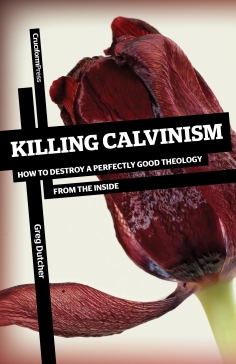
Greg Dutcher, Killing Calvinism: How to Destroy a Perfectly Good Theology From the Inside