Time to Do What the Lord Wills


Photo Print by Laura Evans on Etsy

Some encouraging -and convicting- words from the pen of Elisabeth Elliot on the Discipline of Time:

“My times are in thy hand…” has become a part of my life. When the Lord has left me in agony of waiting over some decision, these words have put me a rest. His timing is always perfect, though it seldom seems to me, for my temperament longs for previews of coming attractions.”


There is always enough time to do the will of God. For that we can never say, “I don’t have time.” When we find ourselves frantic and frustrated, harried and harassed and “hassled,” it is a sign that we are running on our own schedule, not on God’s”

On our way too long to-do lists:

“But the lists must be reviewed daily with the Lord, asking Him to delete whatever is not on His list for us, so that before we go to bed it will be possible to say, “I have finished the work You gave me to do.””

Are you feeling frustrated and worried about your endless lists of things to accomplish and places to go? Maybe it will be a good idea to be reminded of these simple truths:

“Frustration is not the will of God. Of that we can be quite certain. There is time to do anything and everything that God wants us to do. Obedience fits smoothly into His given framework. One thing that most certainly will not fit into it is worry.”


“Direct your time and energy into worry, and you will be deficient in things like singing with grace in your heart, praying with thanksgiving, listening to a child’s account of his school day, inviting a lonely person to supper, sitting down to talk unhurriedly with wife or husband, writing a note to someone who needs it.”


“People wish they had more leisure time. The problem is not too little of it, but too much of it poorly spent.”

On our time spent with the Lord:

“Time management…begins for the Christian with time set aside for God. Other things cannot fall into a peaceful order if this is omitted.”

All these quotes come from the book, Discipline: The Glad Surrender.

Becky

Five Links -On Justification by Faith, Titus 2 Women, and Bible Apps- and Two Questions

This is my new favorite breakfast recipe: Raspberry Ricotta Scones!

This week I came across some great articles that I thought you might enjoy and benefit from as well.

We talk about being justified by faith alone, but maybe you are not really sure what it is meant by that phrase. Well, our friend Christina Langella has a guest post at Theology for Girls which is worth reading (please don’t even try to skim through it, read it carefully. You will not regret it. 😉 ).

“Whether you have been serving God for a little while or a long while, it doesn’t matter. The whole of your Christian faith is grounded in this one doctrine.It is the truth of God’s grace in Christ towards sinners, and it will not only deliver you from the darkness but it will also keep you on solid ground.”

My dear friend Trisha Poff wrote an excellent and timely article on the need of becoming Titus 2 Women.

“I’m watching women dismiss our home-centered calling as they insist on blurring the distinctive roles God has given men and women, sometimes in the name of being “Gospel-focused,” as though biblical womanhood is void of the Gospel dwelling in us richly.”

On the same line, The Gospel Coalition has an article (from February 28, 2013) for women in need of a mentor: How to Be Mentored Without a Mentor that is very practical and encouraging.

“You may be longing for a formal mentor, someone who can sit down and speak into your life each week. Pray and ask God for that tremendous gift. He may grant it. But if he doesn’t, or until he does, seek out resources already available to you in order to be mentored—even at a distance—by other Christians. I often challenge young, busy moms to read one chapter of a good book each day. You can work your way through a number of books that way. And you’re giving your soul something nourishing.”

Lastly (from the archives at Desiring God -2011-) an excellent encouragement to become “addicted” to God’s Word: Man Shall not Live by Facebook Alone

“Let the Bible bring you back to reality over and over during the day.”

My favorite, favorite, app that has helped me do this and also has helped me with my memorization projects is Fighter Verses, also by Desiring God. I love it!

Now the questions:

Considering that two of my links this week have to do with becoming a Titus 2 Woman I thought maybe we could share some about that here.

1. Who have been the most influential mentors -in your vocation as a Christian wife/mother- in your life (women you know personally and/or authors)?

2. Are you purposely mentoring younger women?

My Answers:

1. In my life, I can quickly point to my sister and Nancy Wilson (I am not mentioning men authors, since this is a question about Titus 2 women). I think also of a friend who reminds me (even the way she speaks!) of Elisabeth Elliot. Elisabeth Elliot, by the way, is becoming a mentor to me in this stage of my life. I have also learned (and still learn!) a lot from different godly friends: there is one who always listens attentively while looking you at the eye with her apron on and a “beautiful tomato” on her hand; another whose mouth is full of the Word of God and with whom sometimes I talk on the phone for hours -she is my life editor of the sort-. There is one who prays without ceasing and cooks the best carrot soufflé ever! Others whose example of love and dedication to their children (biological and adopted) and their perseverance in prayer for them -and even hard physical work- have always been a silent challenge that speaks loudly to my life.

2. Yes. But not enough. I am now almost solely focused on my daughters, especially on my oldest who is leaving for college next fall! So much to talk and pray about, so many hugs to give and laughs to share.

Blessings to you and thank you for stopping by,

Becky

The Two Objects Needed to Make a Home


Peasant Family at the Dinner Table by Jozef Israëls

What a great a read is Bed and Board: Plain talk About Marriage by Robert Farrar Capon. I am absolutely loving this book. I posted some quotes from the first four chapters here, and today I want to share with you a few more quotes from chapters 5 and 6.

“I usually say that you need only two things, two pieces of matter, to make a home: a bed and a table. It’s an oversimplification, but it’s a good one…For Bed and Board are the fundamental geographical divisions of the family; they are the chief places, and it is in them and around them that we dance the parts we are given.”

“He who perished by a tree is saved by a tree. He who died by an apple is restored by eating the flesh of his Saviour. Our lust is to be healed by being brought down to one bed, our savagery tamed by the exchanges around a lifelong table. Bed, Board, rooftree and doorway become the choice places of our healing, the delimitations of our freedom. By setting us boundaries, they hold us in; but they trammel the void as well. By confining, they keep track of us -they leave us free to be found, and to find ourselves. The vow of lifelong fidelity to one bed, one woman, becomes the wall at the edge of the cliff that leaves the children free to play a little, rather than be lost at large. Marriage gives us somewhere to be.”

“The bed is the heart of the home, the arena of love, the seedbed of life, and the one constant point of meeting. It is the place where, night by night, forgiveness and fair speech return that the sun go not down upon our wrath; where the perfunctory kiss and the entire ceremonial pat on the backside become unction and grace. It is the oldest, friendliest thing, in anybody’s marriage, the first used and the last left, and no one can praise it enough.”

“We were meant to meet, to sustain and to ease each other, and in the marriage bed we lie down to do just that. It is an island in a sea of troubles, where there is nothing else to do but rest and refresh. Yet how resourceful we are, with our turned backs and stubborns silences, or with our interminable pouts and dreadful debates about What’s Wrong With Us.”

“People admit is hard to pray. Yet they think it’s easy to make love. What nonsense. Neither is worth much when it is only the outcropping of intermittent enthusiasm. Both need to be done without ceasing…”

“The table can make us or break us. It has its own laws and will not change. Food and litter will lie upon it; fair speech and venom will pour across it; it will be the scene of manners and meanness, the place of charity or the wall of division, depending. Depending on what is done with it, at it and about it. But whatever is done, however it enters, it will allow only the possible, not the ideal. No one has ever created the Board by fiat. God himself spread his table, but Judas sat down at it. There is no use in thinking that we all have to do is wish for a certain style of family life, and wait for it to happen. The Board is a union of thing and persons; what it becomes depends on how the thing is dealt with by the persons.”

“The Board will always give birth to liturgy.”

“[I]t is precisely the absence of visible liturgy that nowadays makes the common life less obvious to common men.”

“Few of us have very many great things to care about, but we all have plenty of small ones; and that’s enough for the dance. It is precisely through the things we put on the table, and the liturgies we form around it, that the city is built; caring is more than half the work.”

Under His sun and by His grace,

Becky

The Beauty of Being a Woman

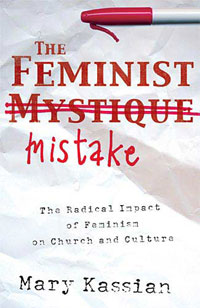
When I was reading through The Feminist Mistake I kept thinking how grateful I am to be a woman and to know that I have been named by God.

So I wrote a small piece about the beauty of being a woman…

Come, read over at Desiring Virtue and share with us what are some of the things you are grateful about being a woman.

Under His grace,

Becky

The Feminist Mistake by Mary Kassian -My Review-

A professing Evangelical woman today will try to say that she is not a Feminist, that she only believes that in marriage (and Church) there should be no hierarchies, that in Christ we all are one and that we, wives, are not longer called to submit to our own husbands, instead we are both (husband and wife) called to submit to one another.  Is this even possible?

Mary Kassian’s book: The Feminist Mistake, The Radical Impact of Feminism on Church and Culture is an extremely important book in all this “gender debate” issue. And it is important because of at least three reasons:

1. It helps us understand the origins, the philosophical and theological views of Feminism and how it found its way into the Church.

2. It also help us understand how it is impossible to be a Feminist and a Christian. You can’t embrace both. Feminism always leads to a “new kind” of theology which has its own hermeneutic methods to interpret the Scriptures, so that it would be able to “support” its own beliefs.

3. It helps us understand that the so called “gender-debate” (egalitarianism vs complementarism), goes beyond the issues like “who takes the final decisions at home.” Feminism leads, little by little, to a complete non-Biblical view of God, and the world.

Kassian’s book is well written, clear, and engaging. It is also well researched and it includes a great number of references. Mary Kassian’s approach is objective, and does not deal with the subject as if she were in a “witch hunt,” she presents a professional historical account, and always from a solid Biblical standpoint.

The book is divided in two parts: The Philosophical Quake and Shock Waves

The first part is subdivided in three stages:

1. Naming Self (here she explains how women decided to name themselves, instead of letting God name them, define who they are).

2. Naming the World  (two of the things she deals about in this stage are: Women-centered Analysis of Theology and Women’s Studies in colleges).

3. Naming God (the feminization of God, and women and their place in the Church are discussed here).

In the second part of her book, Kassian deals with the advent of “biblical feminism,” the hermeneutic methods they use to sustain their “egalitarian” position, the  “what-to-do-know” kind of questions, and what will happen next if we refuse to see the danger feminism represents and we neglect to stand firm against it.

I would like to share with you some quotes on the matter of Feminism and Theology:

“In order to harmonize feminism and religion, Daly found it necessary to reject the theology that presented God as omnipotent, immutable, and providential, for she believed that this view discouraged women from seeking change. Furthermore, she viewed images of a jealous and vengeful God as projections and justifications for the role of the “tyrant father in patriarchal society” rather than as actual aspects of God’s character. The concept of an almighty, all-powerful, unchangeable, caring, providential God, jealous and demanding worship, was, according to Daly, an inadequacy in the conceptualization of basic doctrines which sustained and perpetuated androcentric theological teachings.” (p.47)


“Feminist theolgians, therefore, took the liberty of discarding passages of the Bible that did not agree with their vision of sexual equality. They either dismissed the text as outdated -relative only to a particular time and culture- and the author of the text as misogynistic, or they interpreted it and assigned it a meaning different from what the author had intended. The dynamic view of the Bible that feminists adopted allowed them to adjust biblical interpretations in order to make the Bible relevant to the problems and  perspectives of women in contemporary culture. Feminists argued that biblical interpretation could and should change.” (p. 108)


“Traditional symbols of the church had presented God as “He” and as King, Lord, and Judge. Feminists maintained that these religious symbols excluded women. The symbols needed to be updated to accommodate the new feminist consciousness. According to feminists, linguistics symbols of the Bible and church, as well as of God, needed to be altered in order to bring them into line with the inclusive equality of women.” (p.162)

Ruether and Stendal, two influential feminist theologians, said that “those who imaged God as male were guilty of idolatry,” and that “those who believed that God was, in some way or another, male were guilty of idolatry.” The author rightly responds,

“…by changing the biblical symbols, Russell altered and renamed God. This is a serious matter. For if feminism’s altered view of God is out of synchronization with who God really is, as He has revealed Himself, then it is not really God whom they are imagining and worshiping; and this is the idoaltry that the Bible condemns.” (p.168)

When women start re-naming God and try to de-sexualize Him, what they end up doing, according to the author’s analysis, is they depersonalized God, they attack God’s character,  they deny the Trinitarian relationship, they obscure the person and work of Christ, they obscure humanity’s relationship to God, and their own personal identity (p.168-173).

If you read this book carefully, you will clearly see the philosophical progression of feminism.

Mary Kassian says,

“While I do not deny that feminist vary in political theory and theology, I maintain that are all part of a larger continuum that supersedes and encompasses those variations. A feminist, at any given point in time, may not see herself or himself at the radical end of the movement, and I am certain that some individuals will never change their personal views to that extent. But the dissociation of one’s brand of feminism from the remainder of the feminist movement is a naive denial of reality. The philosophical progression of feminism is both coherent and logically immanent.” (p.241)

Maybe you are one of those who “sees feminism as an ideology that merely promotes the genuine dignity and worth of women.” Read what Mary Kassian wisely says on the matter:

“If this were true (the statement above), feminism would definitely be compatible with Christianity, for the Bible does teach that women and men are of equal value in God’s sight, co-created as bearers of God’s image. But the philosophy of feminism adds a subtle, almost indiscernible twist to the basic biblical truth of woman’s worth. Feminism asserts that woman’s worth is of such a nature that it gives her the right to discern, judge, and govern that truth herself… Feminism does not present itself as at outright affront to the Bible, but it nevertheless contains an insidious distortion that erodes the authority of the Scripture. Acceptance of the feminist thesis may not drastically alter one’s initial beliefs, but if followed, it will naturally and logically lead to an end miles away from the Christianity of the Bible.” (p. 261)

What now? Why should you read this book if you are not a “biblical feminist” (or an egalitarian)? I assure you, sisters, that the rise of this movement is coming more rapidly and with more fury than we can even start to imagine. We need to be ready to discern it and be well grounded in the Word of God to be able to teach our daughters (and sons) the dangers of this lie.

Let us press hard and embrace our precious and wonderful calling which is good, because God said so. Let us not be afraid, sisters, to be named by God, to embrace the beauty of our place in His story.

Then the man said, ‘This at last is bone of my bones and flesh of my flesh; she shall be called Woman, because she was taken out of Man’” Genesis 2:23

Under His sun and by His grace,

Becky

Mary Kassian blogs at Girls Gone Wise, and True Woman

 

*********************


How to Be Persuasive with our Words

Whoever gives thought to the word will discover good,
and blessed is he who trusts in the Lord.
The wise of heart is called discerning,
and sweetness of speech increases persuasiveness.
Good sense is a fountain of life to him who has it,
but the instruction of fools is folly.
The heart of the wise makes his speech judicious
and adds persuasiveness to his lips.
Gracious words are like a honeycomb,
sweetness to the soul and health to the body.

Proverbs 16: 20-24

Not one harsh word, not raising my voice, not many words…. Help me, Lord.

Becky