Truth and Love -Ephesians 4:15-

John Stott writes in his commentary on Ephesians (referring to Eph. 4:1-16):

“Thank God there are those in the contemporary church who are determined at all costs to defend and uphold God’s revealed truth. But sometimes they are conspicuously lacking in love. When they think they smell heresy, their nose begins to twitch, their muscles ripple, and the light of battle enters their eye. They seem to enjoy nothing more than a fight. Others make the opposite mistake. They are determined at all costs to maintain and exhibit brotherly love, but in order to do so are prepared even to sacrifice the central truths of revelation. Both these tendencies are unbalanced and unbiblical. Truth becomes hard if it is not softened by love; love becomes soft if it is not strengthened by truth. The apostle calls us to hold the two together, which should not be difficult for Spirit-filled believers, since the Holy Spirit is himself ‘the spirit of truth,’ and his first fruit is ‘love.” There is no other route than this to a fully mature Christian unity.” (emphasis mine)

I read the Word of God and the words of godly men like Stott and Bonhoeffer, and many others, and I still feel like a broken vessel which knows not how to love others while embracing His Truth, while upholding God’s Word, while giving it preeminence and not compromising it. Stott says that “this should not be difficult for Spirit-filled believers,” I think that is the only line in this quote with which I do not agree. I find it one of the most difficult things to learn. I pray I will always be brave enough to stand strong on the Truth that is so often changed, but humble enough to recognize when I am not loving like Jesus would.

The more I ponder on these things, the more I recognize that only in God we can find perfect justice and perfect love.

Learning under His sun and by His grace,

Becky

*Thanks to Tim Challies who shared this quote on his blog today and to my friend Melissa who pointed it to me.

The Giving of Thanks and My Obedience

@Jim LePage Crux Sola Project

The giving of thanks can only begin when the gift of the divine Word is acknowledged; indeed, only when I am immersed in the study of the divine Word. How could one begin to give thanks to God and not concern oneself with his Word? What kind of thanks would it be to receive the gifts but refuse the required obedience to the giver? It would be a pagan thanksgiving, which is indeed widely practiced.
That is not a giving of thanks to the Lord God, but rather to an impersonal fate or fortune to which I am in no way obligated. Thanks to God that does not proceed from an obedient heart is presumption and falsehood. Only when God’s revealed Word has made our heart want to obey him can we thank God for earthly and heavenly gifts… 

I thank God because I want to learn and know what he requires of me, but I thank him as one who is still only learning, who still lacks everything when measured by God’s righteous judgments. So thanksgiving leads me back to the giving God and then forward to the commanding God, in order finally to find in him his righteousness, which I experience anew as righteousness given to me. “Whoever offers me the sacrifice of thanksgiving honors me; but to those who keep in my way will I show the salvation of God” (Ps. 50:24).”

Bonhoeffer, Meditating on the Word (emphasis mine)

Today as I fix my heart on the Cross, and I am drawn to give Him thanks -over and over again- for His perfect sacrifice, for His atonement, I am also drawn to pray, “Lord, help me to show you my gratitude through my love and obedience to your Word.”

Becky

The Two Objects Needed to Make a Home


Peasant Family at the Dinner Table by Jozef Israëls

What a great a read is Bed and Board: Plain talk About Marriage by Robert Farrar Capon. I am absolutely loving this book. I posted some quotes from the first four chapters here, and today I want to share with you a few more quotes from chapters 5 and 6.

“I usually say that you need only two things, two pieces of matter, to make a home: a bed and a table. It’s an oversimplification, but it’s a good one…For Bed and Board are the fundamental geographical divisions of the family; they are the chief places, and it is in them and around them that we dance the parts we are given.”

“He who perished by a tree is saved by a tree. He who died by an apple is restored by eating the flesh of his Saviour. Our lust is to be healed by being brought down to one bed, our savagery tamed by the exchanges around a lifelong table. Bed, Board, rooftree and doorway become the choice places of our healing, the delimitations of our freedom. By setting us boundaries, they hold us in; but they trammel the void as well. By confining, they keep track of us -they leave us free to be found, and to find ourselves. The vow of lifelong fidelity to one bed, one woman, becomes the wall at the edge of the cliff that leaves the children free to play a little, rather than be lost at large. Marriage gives us somewhere to be.”

“The bed is the heart of the home, the arena of love, the seedbed of life, and the one constant point of meeting. It is the place where, night by night, forgiveness and fair speech return that the sun go not down upon our wrath; where the perfunctory kiss and the entire ceremonial pat on the backside become unction and grace. It is the oldest, friendliest thing, in anybody’s marriage, the first used and the last left, and no one can praise it enough.”

“We were meant to meet, to sustain and to ease each other, and in the marriage bed we lie down to do just that. It is an island in a sea of troubles, where there is nothing else to do but rest and refresh. Yet how resourceful we are, with our turned backs and stubborns silences, or with our interminable pouts and dreadful debates about What’s Wrong With Us.”

“People admit is hard to pray. Yet they think it’s easy to make love. What nonsense. Neither is worth much when it is only the outcropping of intermittent enthusiasm. Both need to be done without ceasing…”

“The table can make us or break us. It has its own laws and will not change. Food and litter will lie upon it; fair speech and venom will pour across it; it will be the scene of manners and meanness, the place of charity or the wall of division, depending. Depending on what is done with it, at it and about it. But whatever is done, however it enters, it will allow only the possible, not the ideal. No one has ever created the Board by fiat. God himself spread his table, but Judas sat down at it. There is no use in thinking that we all have to do is wish for a certain style of family life, and wait for it to happen. The Board is a union of thing and persons; what it becomes depends on how the thing is dealt with by the persons.”

“The Board will always give birth to liturgy.”

“[I]t is precisely the absence of visible liturgy that nowadays makes the common life less obvious to common men.”

“Few of us have very many great things to care about, but we all have plenty of small ones; and that’s enough for the dance. It is precisely through the things we put on the table, and the liturgies we form around it, that the city is built; caring is more than half the work.”

Under His sun and by His grace,

Becky

The Promise of God, a Reality

We are reading a little book: According to Promise by C.H. Spurgeon after breakfast every morning because isn’t it exactly what we need as we start a new day? Don’t we all need to be reminded of His new mercies and never failing promises?

Today the words I read were mingled with grateful tears.

“Yes, the Lord means what He says. He never mocks men with barren words and empty sounds. Why should he deceive his creatures, and ask from them a barren confidence? The Lord may go beyond his word in giving more than it might be thought to mean; but he can never fall short of it. we may interpret his promises upon the most liberal scale. He never falls below the largest rendering which expectation can give to promise. Faith never yet outstripped the bounty of the Lord. Let us embrace the promise, and rejoice that it is substance and not shadow. Let us even now rejoice in it as being the reality of that which we are hoping.” (p.47)

Becky

Life Together by Bonhoeffer -Borrowed Words-


I have read these words over and over again these past days. Lots to think about, to pray, to consider, to discern.

“By sheer grace, God will not permit us to live even for a brief period in a dream world. He does not abandon us to those rapturous experiences and lofty moods that come over like a dream. God is not a God of the emotions but the God of truth.”

“He who loves his dream of a community more than the Christian community itself becomes a destroyer of the latter, even though his personal intentions may be ever so honest and earnest and sacrificial.”

“Christian community is like the Christian’s sanctification. It is a gift of God which we cannot claim. Only God knows the real state of our fellowship, of our sanctification.”

“Where Christ bids me to maintain fellowship for the sake of love, I will maintain it. Where his truth enjoins me to dissolve a fellowship for love’s sake, there I will dissolve it, despite all the protests of my human love. Because spiritual love does not desire but rather serves, it loves the enemy as a brother. It originates neither in the brother nor in the enemy but in Christ and His Word.”

“Because Christ stands between me and others, I dare not desire direct fellowship with them. As only Christ can speak to me in such a way that I may be saved, so others, too, can be saved only by Christ himself. This means that I must release the other person from every attempt of mine to regulate, coerce, and dominate him with my love. The other person needs to retain his independence of me; to be loved for what he is , as one for whom Christ became man, died and rose again, for whom Christ bought forgiveness of sins and eternal life.”

” [Spiritual love] will rather meet the other person with the clear Word of God and be ready to leave him alone with this Word for a long time, willing to release him again in order that Christ may deal with him.”

“Thus this spiritual love will speak to Christ about a brother more than to a brother about Christ. It knows that the most direct way to others is always through prayer to Christ and the love of others is wholly dependent upon the truth of Christ.”

“Human love lives by uncontrolled and uncontrollable dark desires; spiritual love lives in the clear light of service ordered by the truth. Human love produces human subjection, dependence, constarint; spiritual love creates freedom of the brethren under the Word.”

“Therefore, at the beginning of the day let all distraction and empty talk be silenced and let the first thought and the first word belong to him to whom our whole life belongs.”

“The Psalter is great school of prayer.”

“The more deeply we grow into the psalms and the more often we pray them as our own, the more simple and rich our prayers will become.”

“It is not our heart that determines our course, but God’s Word.”

“Prayer should not be hindered by work, but neither should work be hindered by prayer.”

“The prayer of the morning will determine the day. Wasted time, which we are ashamed of, temptations that beset us, weakness and listlessness in our work, disorder and indiscipline in our thinking and in our relations with other people very frequently have their cause in neglect of the morning prayer. The organization and distribution of our time will be better for having been rooted in prayer, The temptations which the working day brings with it will be overcome by this break-through to God…”

“Real silence, real stillness, really holding one’s tongue comes only as the sober consequence of spiritual stillness… If we have learned to be silenced before the Word, we shall also learn to manage our silence and our speech during the day.”

“The Scripture meditation leads to prayer.”

“Intercessory prayer is the purifying bath into which the individual and the fellowship must enter every day.”

“We should listen with the ears of God that we may speak the Word of God.”

“We must be ready to allow ourselves to be interrupted by God.”

“Our brother’s ways are not in our hands; we cannot hold together what is breaking; we cannot keep life in what is determined to die. But God binds elements together in the breaking, creates community in the separation, grants grace through judgment. He has put his Word in our mouth. He wants it to be spoken through us…”

“Sin wants to remain unknown. It shuns the light. In the darkness of the unexpressed it poisons the whole being of a person. This can happen even in the midst of a pious community. In confession the light of the Gospel breaks into the darkness and seclusion of the heart.”

“The greatest psychological insight, ability, and experience cannot grasp this one thing: what sin is…”
In need of His Grace,

Becky

Predestination is the Heavenly Father’s Shout of Eternal Love

Monergism Books

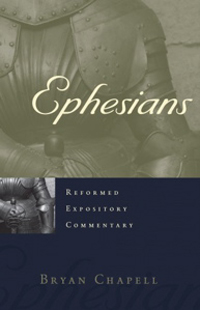
It has been refreshing to read Bryan Chapell’s commentary on Ephesians. The way he explains God’s sovereign election emphasizing His grace is beautiful and encouraging.

So here you are, friends, some borrowed words from this commentary to build your faith. But first, I would like to suggest that you first read Ephesians 1- 2:12, since it is from the commentary of these verses that the following quotes are taken.

“Paul uses the assurance of predestination to strengthen the church for her struggles against evil and discouragement. This perspective does not solve all our logical questions about predestination… Predestination was never meant to be a doctrinal club used to batter people into acknowledgments of God’s sovereignty. Rather, the message of God’s love preceding our accomplishments and outlasting our failures was meant to give us a profound sense of confidence and security in God’s love so that we will not despair in situations of great difficulty, pain, and shame.”  (See Eph. 1: 3-6)


“Paul is using the doctrine of predestination not to separate believers, not to instill pride in our being chosen, nor to vaunt any special knowledge of how God’s works, but simply to assure hard-pressed believers that God has loved them and does love them apart from any merit of their own. In other words, predestination is meant to to bless believers’ hearts. It is not meant for endless argument; it is not an excuse not to evangelize; it is our basis of comfort when we face limitations of our actions, will, and choices. We make mistakes at times by making predestination the source of our pride rather than the basis for assuring the beleaguered whoa re wrestling with their sin and the world’s trials. To such God says, “I loved you before the world began, so don’t doubt me know.” Predestination is the Heavenly Father’s shout of eternal love that echoes in our songs of thankful praise as our strength is renewed by the assurance of his care. When predestination is properly taught, it accomplishes what Paul says is his goal: praise to God for his glorious grace and peace to his people (vv. 3.6)”


“The concept of choosing, which sometimes raises questions about God’s fairness, is actually being used here to comfort God’s people [Eph.1:11-14]. Paul wants everyone to remember that we are loved not because of what is in us but because of what is in God. The loving faithfulness of God that is revealed in Christ is the cause of our being his. The locus, or cause, of the covenant people being God’s is moved from them to him; thay are his because of what is in his heart.”


“Nothing convinces me more of the need for the sovereign initiative of a loving God in my salvation that this assessment in Scripture of my total inability to save myself. The dead cannot save themselves.” (see Eph. 2:3)


“…I must remember to make sure what predestination is really about: the revelation of God’s kindness. Angry arguments and insistent harangues miss the mark when their goal is promoting the doctrine of predestination rather than advancing understanding of divine kindness…

We are not saved by right thinking any more than we are saved by right actions. There is no cause for boasting among those who know that their salvation is a gift of God. Rather, greater humility, love for God, and love for his people flow from those who recognize that their daily existence and eternal destiny are entirely a gift of God.” (see Eph. 2:1-10)


“Benjamin Warfield said that the heart of  Reformed Theology is not predestination but grace…God loving us entirely out of his mercy is the point we miss if we focus on the doctrine of his action rather than on the beauty of his kindness. We will never in this life fully understand the mysteries of his sovereignty, but we can grasp much of his love in his heart. Relishing the kindness of God is the goal that predestination rightly seeks and the emphasis that should remain our message. we will not in this life know why God chooses as he does, but we know enough of Him to rest assured that his choices are good, just, and loving.”

Under His sun and by His grace,

Becky